
1. Does a rescue PFD make any tether arrangement acceptable?
Explain your reasoning before checking the answer.
WR2 / LEARNER HANDBOOK / EDITION 0.2
Assessed team-based river rescue, including approved in-water rescue tasks, water-specific rope systems and casualty movement within the recorded training and operating envelope. The holder works within an appropriately equipped and managed team. The award does not establish competence for every river grade, commercial guiding, incident command, flood response or specialist craft operation.
Draft handbook for review. This course is not yet open.
Our aim is to make high-quality rescue education more accessible. This handbook helps you understand the decisions behind the skills, prepare for your course and revise afterwards.
Read the explanations, try the worked case and answer the questions before checking the reasoning. Bring uncertainties to your instructor. Practical learning uses the approved methods and the actual equipment supplied for your course.
Technical review edition 0.2. The course is not yet open. Practical method sheets, equipment configurations and assessment stations still require technical approval and pilot testing.
Assessed team-based river rescue, including approved in-water rescue tasks, water-specific rope systems and casualty movement within the recorded training and operating envelope. The holder works within an appropriately equipped and managed team. The award does not establish competence for every river grade, commercial guiding, incident command, flood response or specialist craft operation.
Adults aged 18 or over with WR1 competence or an approved evidence-based recognition route covering every WR1 outcome; current relevant first aid; recent river experience; and demonstrated swimming, self-rescue and equipment capability appropriate to the proposed WR2 venue. The instructor records the prerequisite review and practical entry check before higher-exposure tasks. Gaps require learning and fresh observation, not a signed waiver.
Submit WR1 or equivalent evidence and recent river practice for review before attendance.
Review the WR2 scope, method-learning prerequisites and venue information; identify unfamiliar equipment or craft in advance.
Prepare current first-aid evidence and privately discuss any functional support needs.
Bring approved equipment only as agreed; the instructor must check suitability and compatibility before use.
Expect both individual tasks and team scenarios with role rotation. Be ready to explain why a method is suitable and when it must stop.
Coordinate a team intervention only while safety cover, equipment and the recovery plan remain effective.
Before the course, read the explanations and note the terms you do not know. During the course, connect each explanation to the supervised demonstration. Afterwards, use the questions and your practice record to identify what needs refreshing.
A rescue plan describes a change from the present situation to a safer one. Begin by saying what must be protected now, where the person should finish, and what must remain true while they move. The destination may be a bank, a stance, a protected edge or a stable place to wait for help. Choosing a destination before a technique makes it easier to notice a plan that solves one difficulty but creates another.
Separate what you have observed from what you assume. A rope disappearing over an edge does not prove its condition or attachment. A quiet patch of water does not prove a safe exit. State the missing information and decide whether it can be checked without exposing another person. If it cannot, the plan needs a different route or more capable assistance.
The group begins building the first familiar system before anyone checks the landing or exit.
Describe the destination, route, protection and fallback in plain language before selecting equipment.
Use a photograph or tabletop scene. Each learner marks the present protected position, the proposed destination, two uncertainties and the point at which the plan must stop. No live exposure is needed.
Which part of your plan is an observation, and which part is still an assumption?
Knowing how a system was assembled can make an error harder to see: the builder tends to see the intended arrangement. A competent second person should follow the actual connections, rope route and device orientation. The check asks whether the assembled arrangement matches the approved method, whether components are compatible and whether the system can be operated and recovered.
A check is time-specific. Moving an anchor, changing a device mode, adding a load or altering the rope path can invalidate it. Say what changed and obtain the necessary recheck before movement resumes. Inspection is a practical skill with a defined scope; a second person who does not understand the system cannot provide a meaningful independent check.
A checked system is rearranged to make room, and the team assumes the earlier check still applies.
Treat a meaningful change as a new decision point. Identify the affected protection and recheck it.
On an unloaded trainer, the instructor changes one benign configuration detail. Learners explain which part of the earlier inspection is now stale. Do not insert hidden defects into a live safety system.
What would make you ask for a complete recheck rather than a local one?
A message succeeds when the intended person understands the intended action. Names, brief instructions and a confirmation reduce ambiguity, especially when people cannot see the same part of the incident. The team should agree who coordinates movement, how anybody can call a stop and what happens when a message is lost.
Repeating a message is useful only if the sender listens and corrects a misunderstanding. Silence, a nod from someone else or a remembered sequence is not confirmation. Before practical work, test the actual communication method from the positions people will occupy. Wind, water noise, cliff geometry and failed batteries can defeat a method that worked at the briefing.
One person hears lower while another hears hold.
Stop the affected movement and restore a shared understanding through the agreed fallback.
Use a tabletop load marker. A sender, operator and observer run a short movement sequence with one deliberately unclear message. The marker must stay still until the instruction is confirmed.
How will a new team member know which signal stops the exercise?
River observation is a prediction with uncertainty. Watch the direction and speed of surface movement, changing levels, obstacles, bank access and downstream consequences. Then ask what those observations mean for a person or rope entering that flow. Surface appearance alone cannot prove the absence of submerged hazards.
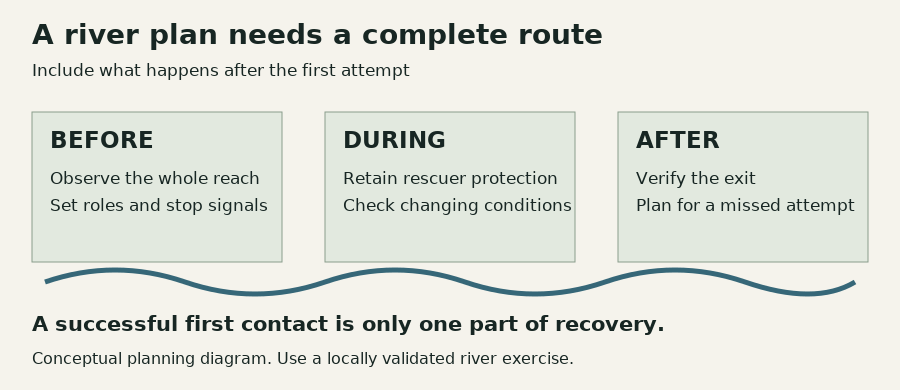
The proposed rescue route includes arrival and recovery, not merely contact with the casualty. A throw that reaches someone can still draw them towards an obstruction or leave them below an inaccessible bank. A suitable plan has a reachable exit, a way to manage a missed attempt and a team able to maintain the agreed safety cover as conditions change.
A convenient throwing position has no usable downstream landing.
Choose the intervention from its likely whole path and recovery point.
From a safe bank or using a site photograph, draw the likely casualty path, the planned exit and the consequences of a miss. Stay outside the marked exposure zone.
Which change in water level would invalidate your chosen exit?
A named downstream team is not enough by itself. Its position, capability, communication and recovery options must suit the actual exercise and the consequences of a missed intervention. Upstream observation also needs a clear route for warnings to reach the people exposed.
Water conditions, debris and bank access can change while the main team is busy. Reassess the whole safety arrangement when the task or conditions change. If a backup team moves to help with the primary task, its original safety function may disappear; replace that function before exposure continues.
Downstream cover is moved to improve the main rescue, leaving no effective missed-attempt response.
Protect the safety functions as explicit roles and stop if they cannot be maintained.
On a site plan, assign primary action, observation, downstream response and recovery. Introduce a rising-level or failed-communication card and revise the plan before any water practice.
Who notices if your backup can no longer reach the likely casualty path?
A rope in moving water can create forces and entrapment routes that are absent in a dry practice area. Anchor positions, line angles, release arrangements and downstream obstacles must be considered together. A system learned for a cliff cannot be transferred into water simply because its components are familiar.
Tethered and contact tasks require a validated method, suitable equipment, specific training and an effective intervention plan. Identify who controls each part of the system and how the team responds if the rescuer cannot act. Initial demonstrations use dry or inert stations; live work starts only after the instructor confirms the approved conditions and protection.
A team imports a familiar rope arrangement into a river without checking its release and snag consequences.
Use the water-specific approved method and verify the full consequence of deployment and release.
Trace rope paths on a dry model, including the released state. Then demonstrate the prescribed checks on the validated station under instructor control.
Where will the rope go if it is released?
A non-powered craft can provide access, support or recovery, but its usefulness depends on the operator, loading, entry and exit points and the river features along the route. Plan how the casualty will be supported and how the team will communicate while the craft is moving.
A successful contact is not the end of the task. Confirm the return or downstream recovery route, the effect of a changing casualty condition and what the shore team will do if the intended landing is missed. Retain the lower-exposure options and escalation route if the craft plan becomes unsuitable.
The craft can reach the casualty but cannot make the intended return or landing with the expected load.
Assess access and recovery as one operation within the approved craft and venue scope.
Use a dry loading and route-planning exercise, followed only by the validated non-powered craft station. Record each learner’s role and response to a scripted change.
What is the planned outcome if the first landing cannot be used?
The casualty’s ability to cooperate is part of method selection. A person who can hear, understand and hold an aid presents a different problem from someone who cannot respond. A method can be technically well executed and still fail because it depends on an action the casualty cannot perform.
Make those dependencies visible during the briefing. State which actions belong to the casualty and which the rescue team can provide. Then consider fatigue, injury, cold and communication loss. If a dependency is no longer reliable, revise the plan within the team’s approved capability and activate additional help rather than repeating the same ineffective attempt.
The team repeats a cooperative rescue method although the casualty’s ability to respond has deteriorated.
Reassess the required cooperation and select a suitable approved response.
Use casualty-description cards in a dry planning exercise. For each option, identify its dependencies, likely failure and recovery arrangement; practical demonstrations use the validated station.
Which change in casualty condition would invalidate your selected method?
An approved water exercise is ready to begin. Before commitment, the downstream safety team reports that rising water has made its planned position unusable.
Hold the intervention. That position was part of the system of protection, so losing it changes the readiness of the whole exercise.
Reassess the venue and the available alternatives. A new position is useful only if the team can reach it, operate from it and recover people effectively under the changed conditions.
Rebrief everyone after a revised plan is approved. If effective cover cannot be restored within the approved operating limits, choose a different exercise or venue. Keeping a timetable is not a reason to continue.
Assuming that a person wearing rescue equipment can replace a lost safety function wherever they stand.
A replacement position is available but the team cannot communicate with it reliably. Identify the unresolved dependency.
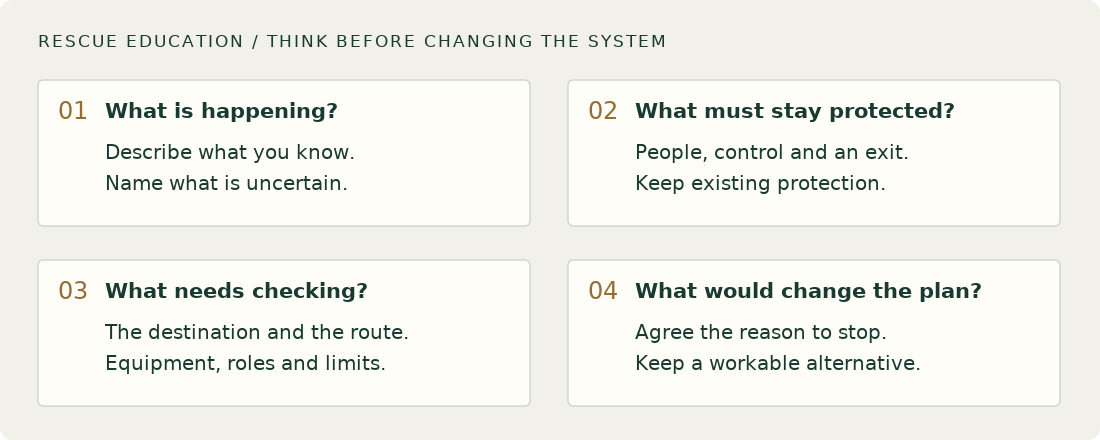
Answer in your own words before reading the explanations near the end of the handbook. These questions support revision; they do not replace practical assessment.
Explain your reasoning before checking the answer.
Explain your reasoning before checking the answer.
Explain your reasoning before checking the answer.
An inspected, approved river reach offering the required task features with reliable access, exit options, communications and independent rescue provision. The local technical plan records the actual conditions and upper/lower operating limits. Tasks involving tethered contact, non-powered craft or water rope systems need their own approved setup and safety plan. If the venue cannot safely support a required practical task, defer that evidence or use another approved venue; do not award a narrower demonstration as unrestricted competence.
WR1 personal and group safety equipment appropriate to the reach
Approved water-specific rescue lines, connectors, compatible anchors and control equipment
Task-appropriate releasable rescue equipment where a validated contact method requires it
Non-powered craft and rescue accessories only where that method is in the programme and staff scope
Casualty packaging and handling equipment suitable for the approved environment
Training mannequins and dry entrapment props
Reliable communications, independent rescue provision and appropriate medical/thermal resources
Current method sheets, manufacturer instructions, venue plan and individual assessment records
A named, authorised water instructor accepts the current programme, exercise method sheets and venue plan before delivery. These draft outcomes do not themselves approve an operational technique.
Inspect the reach and downstream consequences immediately before each session. Record permitted conditions, access and escape points, forecast and upstream release information, water quality, temperature exposure controls and stop triggers. Suspend or relocate whenever the approved envelope is exceeded.
Brief and rehearse the real emergency plan, stop signal, casualty access and communication fallback. Maintain dedicated competent safety cover with immediate rescue capability independent of the candidate being assessed.
Begin any immersion activity with supervised familiarisation in an approved low-consequence setting. Check confidence, equipment fit and ability to stop or exit; offer a stop or alternative without coercion. Missing practical evidence still means not yet demonstrated.
Use approved, compatible water equipment and manufacturer instructions. Verify personal equipment and quick-release arrangements where relevant before exposure; keep defective equipment out of service.
Never deliberately trap a participant, induce unconsciousness, obstruct breathing, simulate drowning through distress, or create an uncontrolled rope or hydraulic hazard. Use dry props, tabletop injects or suitable training mannequins for dangerous casualty states.
Do not deliberately expose learners to natural strainers, undercuts, recirculating hydraulics, culverts, uncontrolled drops or contaminated floodwater. Recognition and avoidance can be assessed from a safe viewpoint or simulation.
Manage loose line, entanglement and stored-energy hazards. A generic climbing rope method or ordinary harness connection is not automatically suitable for moving water. Any water-contact tether task needs a separately approved equipment, release and backup plan.
Protect participants from cold, heat, exhaustion and repeated immersion through suitable clothing, rest, monitoring and an accessible exit. A rushed timetable never overrides individual readiness.
Medical teaching stays within the instructor’s verified remit and current local guidance. Provide appropriate first-aid cover and a clear route to emergency medical assistance.
An assessor’s safety intervention ends that attempt for the affected outcome. Record what happened, practise the gap and observe a fresh attempt; do not mark a coached rescue as an independent pass.
Protect the environment through access permission, appropriate footwear and kit cleaning, biosecurity and lawful waste disposal. Record significant incidents and equipment defects through the scheme process.
Before WR2 exposure, verify all prerequisite outcomes and the candidate’s practical entry capability. A certificate title alone does not establish the required river competence.
A swimmer or contact rescuer enters only under a validated method and explicit task briefing with a viable exit, dedicated backup and a tested communication/release plan. Never tether a person using an improvised attachment arrangement.
A rope system built near moving water must be assessed for water forces, line position, entanglement, release and downstream consequences as well as dry-land strength. Unverified force estimates or a generic mechanical-advantage ratio are not design approval.
For craft work, the instructor and safety team must hold relevant craft competence and the method must be within the venue plan. Powered-craft operation is excluded. If required craft evidence cannot be completed safely, record it as outstanding.
Assessment scenarios introduce changing facts through controlled injects. They must not cause a real failed anchor, lost safety cover, trapped participant, unconscious swimmer or uncontrolled release.
Name the responsible scheme and local operational authority; record venue parameters and evaluator approval in the operating annex. Scheme approval does not replace employer or jurisdictional authorisation.
For training with injury risk, arrange trained and equipped basic life-support cover and an effective emergency response. Any immediately dangerous exercise needs a separately approved rescue and intervention provision; never assume the teaching team alone is adequate.
Use these outcome references with your instructor. Explain your decisions and demonstrate the task under the stated conditions. A safe stop can show judgement; any required physical skill still needs its own observed demonstration.
WR2-A
Demonstrate current competence in the prerequisite personal-safety and shore-response tasks, identify gaps and act within verified limitations before undertaking WR2 work.
A current-looking external certificate has unclear scope or the candidate cannot demonstrate a critical personal skill.
Evidence review plus an observed entry check in the approved setting. All WR1 outcomes are accounted for through current evidence or fresh observation.
A signed prerequisite map records issuer checks, practical observations, gaps and their resolution before advanced exposure.
WR2-B
Assess casualty needs, river hazards, access, downstream consequences and available competence; select a proportionate primary plan and a realistic fallback with clear roles and stop conditions.
The fastest-looking method needs a capability the team does not hold.
An unfamiliar approved river problem with enough information to plan and a deliberate information gap requiring clarification.
Candidate briefs a coherent plan, identifies missing resources and changes or rejects the plan when necessary.
WR2-C
Position and coordinate the competent safety team, identify rescue and escape options, confirm communication and monitor whether the safety arrangement remains effective.
A safety position loses sight of the working area or an exit is no longer usable.
Approved exercise with named independent backup; candidates practise coordination without becoming the sole safety cover.
Observation records an effective initial brief, monitoring and prompt suspension or repositioning before exposure continues.
WR2-D
Demonstrate the approved swimming, manoeuvring and exit skills needed for the assessed reach while managing energy, communication and exposure. Recognise when a task exceeds personal capability.
The candidate must select an alternative approved exit from a pre-briefed change, rather than persist with a poor route.
After familiarisation, individually observed tasks in the validated reach with dedicated safety cover and exposure limits.
Individual record identifies actual features and conditions, successful performance and any intervention. No unassessed river grade is implied.
WR2-E
Choose and execute an approved bank-based or shallow-water intervention where it reduces exposure, maintaining team stability, line awareness and a planned retreat.
A seemingly easy crossing or reaching position is rejected because footing or downstream consequences cannot be verified.
A validated low-consequence task. Any shallow-water entry is separately approved for the actual footing, flow, depth and backup arrangements.
Candidate selects a justified method, demonstrates it within limits and recognises the point to retreat.
WR2-F
Use a validated contact method to approach, communicate with and assist a casualty to the planned safe location while maintaining rescuer control and the ability to abort.
A casualty cannot follow the expected instructions or the planned exit becomes unavailable through a scenario inject.
Only a controlled competent role player or suitable mannequin, approved equipment and method, clear exit and dedicated independent rescue cover. No simulated unconscious live swimmer or intentional panic behaviour.
Direct observation of the approved task and a safe response to the changed fact, including justified abort or escalation.
WR2-G
Explain why a tethered method is justified, verify water-specific equipment and release arrangements, coordinate the tender and backup team and perform the approved task without losing line or rescuer control.
A communication signal is missed or line position becomes unsuitable; the team must stop or recover using the rehearsed plan.
A separately approved tethered exercise using manufacturer-compatible rescue equipment, rehearsed release and recovery, dedicated backup and a safe operating envelope. Dry rehearsal precedes water exposure.
Individual evidence covers the candidate’s rescuer and support roles, checks, communications and controlled response; any critical intervention requires reassessment.
WR2-H
Choose an approved system suited to the task, explain its load path and foreseeable movement, check compatibility and protect people from line, edge and stored-energy hazards.
A convenient anchor cannot be verified or a planned line crosses an occupied swimming area.
Dry inspection and controlled practical setup using validated design limits and manufacturer information; no improvised live testing of unknown capacity.
Candidate identifies the unacceptable feature, selects a defensible alternative and completes a documented system check.
WR2-I
Coordinate the approved movement or stabilisation task with clear commands, safe line management, monitoring and a workable stop/release plan. Maintain casualty and rescuer protection throughout.
A change in alignment or communication requires a controlled stop and reassessment.
A validated river exercise selected by the technical lead, preceded by dry rehearsal and backed by independent safety provision. Only systems included in the approved WR2 method register count.
Assessor records individual roles, checks, decisions and controlled execution. Team completion does not replace individual evidence.
WR2-J
Gather reliable information, distinguish casualty entrapment from equipment pinning, identify immediate exposure and select a proportionate plan within available competence and equipment.
The first report says a person is pinned, but further information changes the location or casualty state.
Dry props, maps or mannequins only for trapped-casualty tasks; never deliberate live entrapment or an uncontrolled loaded release.
Candidate revises the plan, protects the team and explains limits. Any practical release task uses an approved controlled simulation.
WR2-K
Prepare and operate the approved non-powered craft as part of a controlled river rescue task, demonstrating the prescribed operating and rescue roles, communication, stability, positioning, line awareness and recovery plan within the recorded scope.
The craft cannot reach or hold the planned position, so the candidate must choose an alternative or stop.
A mandatory practical exercise using the craft type, roles and task fixed in the versioned approved method register, with competent craft staff, suitable equipment, validated venue conditions and independent rescue capability. If this exercise cannot be delivered safely, record the outcome as outstanding and withhold the WR2 pass.
Direct observation of preparation, communication, controlled task and recovery; a tabletop discussion alone does not satisfy required craft performance.
WR2-L
Protect the casualty during exit, handling and transfer, communicate with them where possible, monitor relevant changes and arrange timely medical handover within first-aid competence.
The usual bank exit becomes unsuitable or the casualty’s reported condition changes.
A controlled role player or mannequin with approved handling equipment and a safe bank transfer route. Hazardous casualty states are described verbally.
Assessor records safe handling, justified route change, communication and a concise medical handover.
WR2-M
Recognise loss of the approved operating envelope, stop or revise activity, maintain accountability and request appropriate specialist resources. Identify explicit limits involving floodwater, vehicles, culverts and other excluded environments.
A rising-water report arrives during a rescue, or the task changes to a vehicle near a culvert.
A controlled scenario inject and a separate tabletop specialist incident. Real deterioration always stops the training exercise.
Candidate makes a defensible stop, replan or referral decision and briefs the team without attempting an excluded task.
WR2-N
Integrate planning, personal safety, technical work, communication and casualty handover in an unfamiliar approved problem, then complete records, equipment checks and a useful debrief.
A resource constraint or changed casualty information requires a safe revision rather than rote completion of the original plan.
At least two contrasting controlled scenarios with individual role rotation and sufficient observation to cover every required outcome. The technical lead validates the scenario selection and evidence sufficiency.
Assessor records individual outcome evidence, conditions, task roles, interventions and rationale for the decision; unresolved critical gaps prevent a pass.
Start with the information in the problem. State your assumptions, choose a safe objective and explain what would make you change the plan. Apply technical skills only in the approved supervised exercise.
A group incident leaves a swimmer and loose equipment in different locations while the usual access point is blocked.
Priorities, task and safety planning, bank-based versus contact options, accountability, communications and casualty recovery.
Use an approved controlled swimmer or mannequin arrangement. Equipment position and blocked access may be described rather than physically created. Dedicated safety cover remains outside the candidate team.
A planned contact rescue becomes unsuitable when new information removes the preferred exit.
Reassessment, safe abort or alternative, tether/line awareness where included, team communication and casualty protection.
The actual backup exit remains open. The change is a scenario inject, never a physical obstruction imposed after a live rescuer commits.
A report of a pinned paddler is incomplete and the first proposed rope system would expose helpers to stored energy.
Information gathering, casualty priorities, system reasoning, exclusion zones, specialist limits and revised plan.
Use dry props or a mannequin. No live person is trapped, no unknown anchor is loaded and no uncontrolled release is performed.
A non-powered craft rescue is considered but the planned position is unsuitable for the actual conditions.
Craft suitability, team competence, alternative methods, communication and no-go judgement.
Inspect and brief before commitment. Use a controlled practical task or pre-entry inject, not a deliberate capsize or uncontrolled line attachment.
Several people need accounting for while a rising-water report and a communication problem affect the original plan.
Leadership within role, revised limits, allocation of resources, casualty handover and escalation.
All participants remain accounted for by exercise control. Worsening conditions are simulated; real deterioration ends the exercise.
The team is asked to extend a river rescue into a flooded road and vehicle incident near a culvert.
Recognition of excluded scope, safe information gathering, prevention of further exposure and request for specialist resources.
Tabletop only. This scenario tests boundaries and cannot be used as evidence of vehicle, flood or culvert rescue competence.
The assessor records your individual decisions and practical performance. The ratings are I for independent and safe, C for coached or incomplete, N for not observed and S for a safety intervention. A missing or unsafe outcome cannot be balanced by a strong performance elsewhere.
The course instructor records teaching and practice. A separately approved assessor records competence, and the scheme checks the certification decision. You can ask for the reasons for a result and use the appeal route if you disagree.
If evidence is incomplete, you receive the observed gaps and a targeted practice plan. Reassessment checks the affected skills and their interaction in a scenario. Use the private support route for an appeal or a correction to your record.
After a recorded pass, submit the short course evaluation. Critical feedback and positive feedback have exactly the same effect on eligibility. Your certificate includes the assessment date, instructor, programme edition and a verification code. An award image alone is not a verifiable credential.
Keep a short record for each practice session. Do not enter unnecessary medical details or another person’s private information. A practice log supports learning; the course record and award remain in the portal.
Date and location
Skill or outcome reference
Conditions and equipment or method reference
What I did and why
Feedback and any intervention
What I will practise next and with whom
No. Fit, the harness and release arrangement, compatible equipment and the method all need to match the specific model and approved task. Practise the actual configuration under controlled supervision.
It may fail to achieve the intended movement or create a new constraint. The team needs a workable way to stop and recover people and equipment.
No. Access, hydraulics, obstructions, temperature, flow changes and help available can differ. Re-establish the operating limits for this site.
Operating limits — The approved conditions within which a particular team, method and venue may be used.
Safety cover — People, positions, equipment and actions arranged to protect a specific activity.
Tether — A connecting line that can restrain movement and introduce additional forces and entanglement hazards.
Release function — The intended way to separate from a connection under the conditions specified for the equipment and method.
Use the current instructions for the exact model of equipment on your course. Check its intended use, compatible components, inspection points and operating limits. A similar-looking device may behave differently.
Ask your instructor to show how the approved method sheet and equipment instructions fit together. Report anything that is unclear before practical use. The references below are selected primary sources; they do not certify this course.
Resuscitation Council UK First Aid Guidelines 2025 published 27 October 2025; checked 6 November 2026
Medical teaching must use current locally adopted first-aid and drowning protocols. UK guidance is a review source, not a universal jurisdictional rule.