
1. Why can less sag increase concern in a spanning system?
Explain your reasoning before checking the answer.
RR3 / LEARNER HANDBOOK / EDITION 0.2
An advanced award for planning and directing complex rope rescue systems, including offset and spanning operations, within the recorded environment and organisation’s command arrangements.
Draft handbook for review. This course is not yet open.
Our aim is to make high-quality rescue education more accessible. This handbook helps you understand the decisions behind the skills, prepare for your course and revise afterwards.
Read the explanations, try the worked case and answer the questions before checking the reasoning. Bring uncertainties to your instructor. Practical learning uses the approved methods and the actual equipment supplied for your course.
Technical review edition 0.2. The course is not yet open. Practical method sheets, equipment configurations and assessment stations still require technical approval and pilot testing.
An advanced award for planning and directing complex rope rescue systems, including offset and spanning operations, within the recorded environment and organisation’s command arrangements.
Current RR2 or documented equivalent accepted by a qualified technical reviewer, with observed lower-level capability and evidence of relevant team experience. Current first aid/CPR. Candidate must be able to explain system forces and operate the lower-level methods before advanced system work.
Read the student pack and scope limits; identify the local response route and communication limitations.
Bring required inspected personal equipment or arrange provider equipment in advance.
Discuss adjustments and ability to participate privately with the provider; avoid uploading unnecessary medical details to the registry.
Review prerequisite skills and current first aid/CPR; submit qualification references where entry requires them.
Expect flexible practice time and individual evidence for every outcome. Ask to stop whenever protection or understanding is uncertain.
Explain and independently review a complex rescue plan, including its limits, dependencies and response to change.
Before the course, read the explanations and note the terms you do not know. During the course, connect each explanation to the supervised demonstration. Afterwards, use the questions and your practice record to identify what needs refreshing.
A rescue plan describes a change from the present situation to a safer one. Begin by saying what must be protected now, where the person should finish, and what must remain true while they move. The destination may be a bank, a stance, a protected edge or a stable place to wait for help. Choosing a destination before a technique makes it easier to notice a plan that solves one difficulty but creates another.
Separate what you have observed from what you assume. A rope disappearing over an edge does not prove its condition or attachment. A quiet patch of water does not prove a safe exit. State the missing information and decide whether it can be checked without exposing another person. If it cannot, the plan needs a different route or more capable assistance.
The group begins building the first familiar system before anyone checks the landing or exit.
Describe the destination, route, protection and fallback in plain language before selecting equipment.
Use a photograph or tabletop scene. Each learner marks the present protected position, the proposed destination, two uncertainties and the point at which the plan must stop. No live exposure is needed.
Which part of your plan is an observation, and which part is still an assumption?
Knowing how a system was assembled can make an error harder to see: the builder tends to see the intended arrangement. A competent second person should follow the actual connections, rope route and device orientation. The check asks whether the assembled arrangement matches the approved method, whether components are compatible and whether the system can be operated and recovered.
A check is time-specific. Moving an anchor, changing a device mode, adding a load or altering the rope path can invalidate it. Say what changed and obtain the necessary recheck before movement resumes. Inspection is a practical skill with a defined scope; a second person who does not understand the system cannot provide a meaningful independent check.
A checked system is rearranged to make room, and the team assumes the earlier check still applies.
Treat a meaningful change as a new decision point. Identify the affected protection and recheck it.
On an unloaded trainer, the instructor changes one benign configuration detail. Learners explain which part of the earlier inspection is now stale. Do not insert hidden defects into a live safety system.
What would make you ask for a complete recheck rather than a local one?
A message succeeds when the intended person understands the intended action. Names, brief instructions and a confirmation reduce ambiguity, especially when people cannot see the same part of the incident. The team should agree who coordinates movement, how anybody can call a stop and what happens when a message is lost.
Repeating a message is useful only if the sender listens and corrects a misunderstanding. Silence, a nod from someone else or a remembered sequence is not confirmation. Before practical work, test the actual communication method from the positions people will occupy. Wind, water noise, cliff geometry and failed batteries can defeat a method that worked at the briefing.
One person hears lower while another hears hold.
Stop the affected movement and restore a shared understanding through the agreed fallback.
Use a tabletop load marker. A sender, operator and observer run a short movement sequence with one deliberately unclear message. The marker must stay still until the instruction is confirmed.
How will a new team member know which signal stops the exercise?
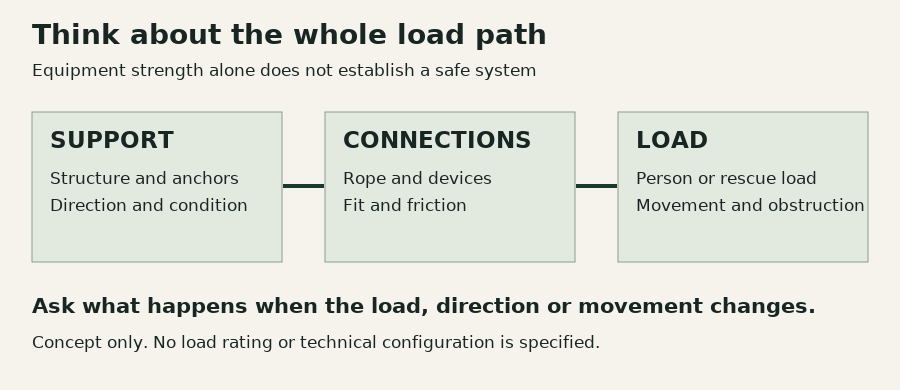
A system is a connected set of load paths, controls and people. Start at the casualty and follow each load path to its anchor. Identify what supports the load, what controls movement, what limits the consequences of a mistake and what could affect more than one line at once. Two ropes over the same unprotected sharp edge can share the same vulnerability.
A component strength marking describes a test or product property, not the complete rescue system. Geometry, connection orientation, edge contact, dynamic movement and device behaviour all matter. Calculations help explain a system, but the approved method must also be supported by compatible equipment, appropriate testing, inspection and operational limits.
The team calls a system redundant because it contains two ropes.
Check whether a single event could compromise both paths and whether the complete arrangement stays within the approved method.
Draw two independent-looking paths on a board, then add a shared edge or anchor feature. Ask the group to identify common failure points and propose a safer approved arrangement.
What does the second path protect against, and what does it share?
Spanning and offset systems can magnify the consequences of geometry. Load position, rope direction, movement and tension interact; a neat drawing or a simple ratio cannot establish the forces in every part of the real system. The analysis must match the actual approved configuration and its expected range of movement.
Increasing tension can appear to improve clearance while increasing demand elsewhere. Use the validated method, limits and technical review for the specific equipment and anchors. If the desired path cannot be achieved within that envelope, change the plan rather than progressively tightening the system until it looks right.
The team adds tension to improve clearance without reassessing anchor and directional demands.
Check the whole configuration and movement envelope before altering tension.
Use an abstract tabletop model or approved instrumented low-load trainer to compare geometry changes. No person is suspended and no operational capacity is inferred from the model.
Which component or anchor sees a different direction as the load travels?
An elevated directional changes the rope path and can improve an edge transition, but it introduces its own stability and connection questions. Evaluate the complete arrangement: support points, ground, restraints, rope directions, load movement and the manufacturer’s configuration limits.
Stability must be considered throughout the movement, including start, finish and any change of direction. A configuration that appears stable with an unloaded rope may behave differently when the load moves. The competent technical lead must approve the exact arrangement, and the operating team must understand what changes require a stop and reassessment.
A directional is positioned for the first part of the movement but not the final load direction.
Analyse the full movement envelope and verify the approved configuration before use.
Review a manufacturer-approved configuration drawing selected by the instructor. Mark the predicted changes in direction and the inspection points; practical work uses the validated inert station.
Which assumption about stability depends on the casualty staying in one place?
Technical leadership means making the plan understandable enough for others to challenge it. State the intended route, loads, controls, dependencies and fallback. Invite a competent reviewer to test assumptions, including what happens if movement stops at an awkward position.
When an operation is interrupted, avoid restarting merely because the immediate problem has disappeared. Re-establish the current system state, account for people and equipment, confirm the reason for the interruption and verify any changes. Record the decision and the evidence needed for a later handover or review.
After a communication failure, the team resumes from memory without checking whether positions or controls changed.
Rebrief from the actual current state and obtain the required rechecks.
Run a tabletop complex rescue with a scripted interruption. Learners alternate technical lead and independent reviewer, then record the revised plan and unresolved assumptions.
What would a competent reviewer need to see before agreeing to restart?
A calculation answers a defined question using stated assumptions. It may estimate a force or describe geometry, but it does not by itself establish equipment compatibility, anchor condition, operator competence or acceptable consequences of failure. Write the assumptions alongside the result so the reviewer can see what would invalidate it.
A technical approval brings several kinds of evidence together: the calculation where appropriate, the approved configuration, manufacturer information, relevant testing, site inspection and the operational plan. When those disagree, stop and resolve the discrepancy. Selecting the most reassuring result from several sources is not an engineering review.
A spreadsheet result is treated as permission to use a configuration that has not been validated.
Identify what the calculation proves and what still requires independent evidence.
Review a fictional analysis sheet with clearly stated assumptions. Mark each item as calculated, observed, specified by the manufacturer or still unverified. No live system is built from the exercise.
Which assumption has the greatest effect on the conclusion?
A proposed spanning system has been reviewed on paper. At the site, one support position is unavailable. A replacement position changes the angle and the rope route.
Treat the revised geometry as a design change. Identify which loads, clearances, anchors and stability assumptions depend on the old position.
Recalculate and review within the approved design method, using verified inputs and appropriate allowances. Record unresolved inputs; an attractive diagram cannot supply missing site information.
Agree who independently checks the revision and which conditions will stop the operation. Keep the rescue objective open to simpler alternatives if the revised system cannot be justified.
Preserving the original method by quietly changing an input that the reviewer relied on.
The available measuring instrument cannot resolve an important input accurately enough. Explain how that uncertainty affects the decision to proceed.
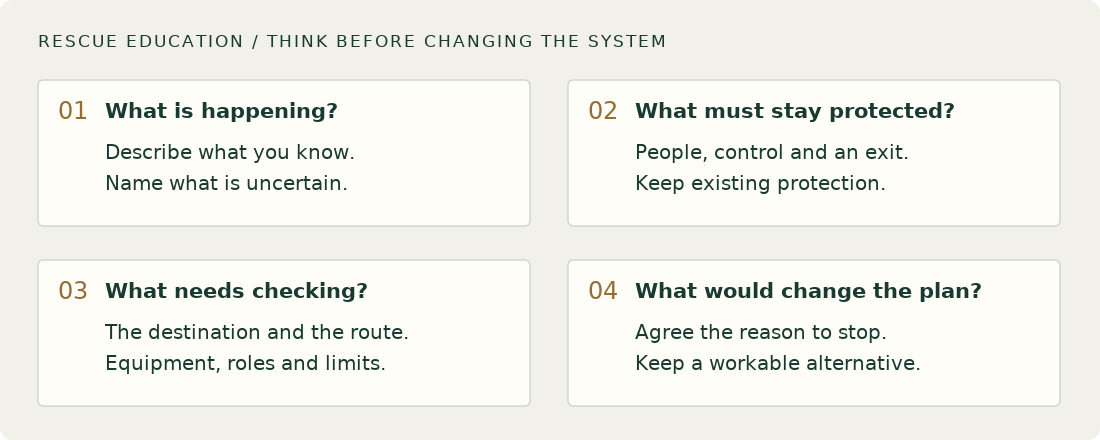
Answer in your own words before reading the explanations near the end of the handbook. These questions support revision; they do not replace practical assessment.
Explain your reasoning before checking the answer.
Explain your reasoning before checking the answer.
Explain your reasoning before checking the answer.
A specialist training venue with separately verified anchors, sufficient span/clearance, controlled access and an engineered or technically approved operating envelope for each advanced system. Prove configurations with test loads before any permitted person loading; operate one exposed complex evolution at a time.
Inspected rescue ropes and compatible control, ascent and backup devices
Suitable harnesses, helmets, footwear, gloves and environmental protection
Connectors, slings and anchor equipment with traceable inspection records
Rope and edge protection secured for expected movement
Casualty carrier, attachment system and training manikin or suitable test loads
Communications with an agreed backup signal and method
First-aid equipment and documented participant recovery resources
Manufactured high directional and compatible rigging with current instructions
Resources for protected casualty-access and transition exercises
Technically approved span/offset apparatus, monitoring and test loads appropriate to the chosen systems
Use only methods released for this programme version and current equipment instructions.
Verify anchors, compatibility, load paths, protection and recovery before loading.
Maintain prescribed protection during every transition; prove the receiving system before releasing the previous support.
No uncontrolled descent, dropped load or intentional shock loading is part of assessment.
Stop when safety, communication, environmental limits or recovery capability is compromised.
A serious safety intervention prevents a pass for that attempt; record the event, provide learning and reassess through a new documented attempt.
Do not trade patient protection for task speed.
Record each candidate’s actions and judgement; a successful team operation does not pass every member.
Name the responsible scheme and local operational authority; record venue parameters and evaluator approval in the operating annex. Scheme approval does not replace employer or jurisdictional authorisation.
For training with injury risk, arrange trained and equipped basic life-support cover and an effective emergency response. Any immediately dangerous exercise needs a separately approved rescue and intervention provision; never assume the teaching team alone is adequate.
Use these outcome references with your instructor. Explain your decisions and demonstrate the task under the stated conditions. A safe stop can show judgement; any required physical skill still needs its own observed demonstration.
RR3-A
Evaluate multidirectional forces and system limitations before committing to an offset or spanning rescue. Explain the decision, perform the task without coaching at final assessment and identify conditions that require stopping or escalation. All critical safety controls apply; a correct final setup does not excuse an unsafe transition.
A shorter spanning option raises system tension and reduces clearance. Compare the tradeoffs.
Use the programme-approved venue, current method register, compatible inspected equipment and independent safety arrangements. The assessor states the task and scope before starting; clarification is allowed, coaching is not. Use dry planning or controlled test loads first; exposed application follows the approved technical plan.
Document a load-path sketch, operating envelope, independent check and recovery plan. Record the date, venue/conditions, method edition, observable actions, decision rationale and assessor. A knowledge answer may supplement but not replace required practical observation.
RR3-B
Construct and control transport and reeving arrangements, with justified tension management and protection against foreseeable system failures. Explain the decision, perform the task without coaching at final assessment and identify conditions that require stopping or escalation. All critical safety controls apply; a correct final setup does not excuse an unsafe transition.
Available anchors or operating positions differ from the original sketch. Recalculate the concept and reject it if needed.
Use the programme-approved venue, current method register, compatible inspected equipment and independent safety arrangements. The assessor states the task and scope before starting; clarification is allowed, coaching is not. Use dry planning or controlled test loads first; exposed application follows the approved technical plan.
Demonstrate each approved architecture; operate a representative system with a training load and record each candidate’s control role. Record the date, venue/conditions, method edition, observable actions, decision rationale and assessor. A knowledge answer may supplement but not replace required practical observation.
RR3-C
Plan and control lateral movement using an appropriate offset or cross-haul arrangement while managing swing and load-direction changes. Explain the decision, perform the task without coaching at final assessment and identify conditions that require stopping or escalation. All critical safety controls apply; a correct final setup does not excuse an unsafe transition.
Loss of an offset component would create an unacceptable swing. Design or select a safer plan.
Use the programme-approved venue, current method register, compatible inspected equipment and independent safety arrangements. The assessor states the task and scope before starting; clarification is allowed, coaching is not. Use dry planning or controlled test loads first; exposed application follows the approved technical plan.
Candidate directs rigging and controls an operational offset evolution with a validated contingency. Record the date, venue/conditions, method edition, observable actions, decision rationale and assessor. A knowledge answer may supplement but not replace required practical observation.
RR3-D
Choose and manage a manufactured high directional configuration whose stability is justified for every stage of the rescue. Explain the decision, perform the task without coaching at final assessment and identify conditions that require stopping or escalation. All critical safety controls apply; a correct final setup does not excuse an unsafe transition.
A high directional is stable initially but not throughout travel. Identify the critical stage.
Use the programme-approved venue, current method register, compatible inspected equipment and independent safety arrangements. The assessor states the task and scope before starting; clarification is allowed, coaching is not. Use dry planning or controlled test loads first; exposed application follows the approved technical plan.
Candidate explains resultant changes and manufacturer limits, rigs and monitors a controlled test-load evolution. Record the date, venue/conditions, method edition, observable actions, decision rationale and assessor. A knowledge answer may supplement but not replace required practical observation.
RR3-E
Access a suspended training casualty and transfer support into a recoverable rescue system while maintaining patient and rescuer protection. Explain the decision, perform the task without coaching at final assessment and identify conditions that require stopping or escalation. All critical safety controls apply; a correct final setup does not excuse an unsafe transition.
The casualty system cannot simply be released. Explain a controlled transfer using the approved method.
Use the programme-approved venue, current method register, compatible inspected equipment and independent safety arrangements. The assessor states the task and scope before starting; clarification is allowed, coaching is not. Use dry planning or controlled test loads first; exposed application follows the approved technical plan.
Independent assessment with a manikin or approved simulated load and dedicated safety supervision. Record the date, venue/conditions, method edition, observable actions, decision rationale and assessor. A knowledge answer may supplement but not replace required practical observation.
RR3-F
Move between approved rope systems and re-anchors while maintaining the prescribed attachments and checking the receiving system. Explain the decision, perform the task without coaching at final assessment and identify conditions that require stopping or escalation. All critical safety controls apply; a correct final setup does not excuse an unsafe transition.
Your destination rope has not been checked. Demonstrate what must happen before transferring commitment.
Use the programme-approved venue, current method register, compatible inspected equipment and independent safety arrangements. The assessor states the task and scope before starting; clarification is allowed, coaching is not. Use dry planning or controlled test loads first; exposed application follows the approved technical plan.
Separate evidence for parallel transfer and re-anchor negotiation in both directions. Record the date, venue/conditions, method edition, observable actions, decision rationale and assessor. A knowledge answer may supplement but not replace required practical observation.
RR3-G
Restore controlled movement to a fixed loaded system without an uncontrolled release or transfer. Explain the decision, perform the task without coaching at final assessment and identify conditions that require stopping or escalation. All critical safety controls apply; a correct final setup does not excuse an unsafe transition.
A person is simulated on a non-releasable fixed line. Recover control without shock-loading.
Use the programme-approved venue, current method register, compatible inspected equipment and independent safety arrangements. The assessor states the task and scope before starting; clarification is allowed, coaching is not. Use dry planning or controlled test loads first; exposed application follows the approved technical plan.
Individual test-load evolution with a before/after support-path explanation and a rehearsed safety intervention. Record the date, venue/conditions, method edition, observable actions, decision rationale and assessor. A knowledge answer may supplement but not replace required practical observation.
RR3-H
Lead a complex rescue plan, allocate competent roles, manage verification and change, and stop or escalate when the operational envelope is exceeded. Explain the decision, perform the task without coaching at final assessment and identify conditions that require stopping or escalation. All critical safety controls apply; a correct final setup does not excuse an unsafe transition.
The proposed rescue exceeds the team’s competence or equipment. Explain and lead a safe alternative.
Use the programme-approved venue, current method register, compatible inspected equipment and independent safety arrangements. The assessor states the task and scope before starting; clarification is allowed, coaching is not. Use dry planning or controlled test loads first; exposed application follows the approved technical plan.
Two contrasting scenarios, including one where the correct action is to defer the proposed complex system. Record the date, venue/conditions, method edition, observable actions, decision rationale and assessor. A knowledge answer may supplement but not replace required practical observation.
RR3-I
Challenge assumptions, allocate an independent checker and document why the complete rescue configuration remains within the approved envelope. Explain the decision, perform the task without coaching at final assessment and identify conditions that require stopping or escalation. All critical safety controls apply; a correct final setup does not excuse an unsafe transition.
A colleague treats a printed breaking strength as an allowable working load. Review the complete plan.
Use the programme-approved venue, current method register, compatible inspected equipment and independent safety arrangements. The assessor states the task and scope before starting; clarification is allowed, coaching is not. Use dry planning or controlled test loads first; exposed application follows the approved technical plan.
Candidate reviews a flawed plan, identifies the unsafe assumption and requires an appropriate revision before operation. Record the date, venue/conditions, method edition, observable actions, decision rationale and assessor. A knowledge answer may supplement but not replace required practical observation.
RR3-J
Respond to a failed communication channel, changed weather or unavailable component by stopping safely, recovering the system and selecting a defensible continuation or evacuation. Explain the decision, perform the task without coaching at final assessment and identify conditions that require stopping or escalation. All critical safety controls apply; a correct final setup does not excuse an unsafe transition.
A communications failure occurs while the load is between operating positions. Show safe recovery and team control.
Use the programme-approved venue, current method register, compatible inspected equipment and independent safety arrangements. The assessor states the task and scope before starting; clarification is allowed, coaching is not. Use dry planning or controlled test loads first; exposed application follows the approved technical plan.
Independent scenario with a previously undisclosed change; document a safe recovery, handover and corrective learning. Record the date, venue/conditions, method edition, observable actions, decision rationale and assessor. A knowledge answer may supplement but not replace required practical observation.
Start with the information in the problem. State your assumptions, choose a safe objective and explain what would make you change the plan. Apply technical skills only in the approved supervised exercise.
A simulated casualty needs combined horizontal and vertical movement where a simple lower is unsuitable.
Plan and explain loads; choose and rig a suitable approved system; allocate checks; direct and control the movement.
Technical plan approved before session; test-load rehearsal, protected access and one complex evolution at a time.
A simulated casualty is held on a fixed system that cannot be operated normally.
Protected access, casualty transfer or fixed-system recovery, controlled movement and handover.
Use a manikin/test load and dedicated backup/recovery capability; no live trapped casualty.
The obvious complex rig exceeds an anchor, equipment, team or environmental limit.
Identify the limiting assumption, stop the proposal, choose an acceptable alternative or escalate.
Tabletop or unloaded model; do not create the unsafe arrangement at height.
Communications or an operational resource becomes unavailable during a simulated complex rescue.
Safe holding state, team accountability, revised recovery plan, independent checks and lessons recorded.
Information-only inject; retain actual safety communications and recovery resources throughout.
The assessor records your individual decisions and practical performance. The ratings are I for independent and safe, C for coached or incomplete, N for not observed and S for a safety intervention. A missing or unsafe outcome cannot be balanced by a strong performance elsewhere.
The course instructor records teaching and practice. A separately approved assessor records competence, and the scheme checks the certification decision. You can ask for the reasons for a result and use the appeal route if you disagree.
If evidence is incomplete, you receive the observed gaps and a targeted practice plan. Reassessment checks the affected skills and their interaction in a scenario. Use the private support route for an appeal or a correction to your record.
After a recorded pass, submit the short course evaluation. Critical feedback and positive feedback have exactly the same effect on eligibility. Your certificate includes the assessment date, instructor, programme edition and a verification code. An award image alone is not a verifiable credential.
Keep a short record for each practice session. Do not enter unnecessary medical details or another person’s private information. A practice log supports learning; the course record and award remain in the portal.
Date and location
Skill or outcome reference
Conditions and equipment or method reference
What I did and why
Feedback and any intervention
What I will practise next and with whom
For a given suspended load and simplified symmetric geometry, making the support legs more horizontal increases their required tension. Actual design also depends on pretension, movement and other conditions.
The reviewer tests the assumptions, calculations, dependencies, equipment limits and contingencies. Repeating the designer’s conclusion is not a review.
Re-establish the actual system state, personnel readiness and relevant environmental conditions before restarting. The earlier authorisation may no longer describe the site.
Design assumption — An input treated as true for a calculation or plan; it must be verified or bounded.
Resultant force — The combined effect of forces, accounting for direction as well as magnitude.
Pretension — Tension introduced before the intended operating load is applied.
Design envelope — The range of conditions within which a reviewed design is intended to operate.
Use the current instructions for the exact model of equipment on your course. Check its intended use, compatible components, inspection points and operating limits. A similar-looking device may behave differently.
Ask your instructor to show how the approved method sheet and equipment instructions fit together. Report anything that is unclear before practical use. The references below are selected primary sources; they do not certify this course.
Petzl Professional Catalogue Technical Rescue 2026
Corroborates that a labelled ratio is not measured system performance; no product configurations or capacities adopted.