
1. Why plan a change from raising to lowering before it is needed?
Explain your reasoning before checking the answer.
RR2 / LEARNER HANDBOOK / EDITION 0.2
A technical team-member award for vertical casualty movement, edge management and approved access/rescue transitions, within the recorded environment.
Draft handbook for review. This course is not yet open.
Our aim is to make high-quality rescue education more accessible. This handbook helps you understand the decisions behind the skills, prepare for your course and revise afterwards.
Read the explanations, try the worked case and answer the questions before checking the reasoning. Bring uncertainties to your instructor. Practical learning uses the approved methods and the actual equipment supplied for your course.
Technical review edition 0.2. The course is not yet open. Practical method sheets, equipment configurations and assessment stations still require technical approval and pilot testing.
A technical team-member award for vertical casualty movement, edge management and approved access/rescue transitions, within the recorded environment.
Current RR1 or a documented equivalent accepted by a qualified technical reviewer, followed by an observed prerequisite check. Current first aid/CPR. Evidence of consolidation of RR1 skills in the intended environment. A missing prerequisite outcome requires teaching and assessment rather than a paper exemption.
Read the student pack and scope limits; identify the local response route and communication limitations.
Bring required inspected personal equipment or arrange provider equipment in advance.
Discuss adjustments and ability to participate privately with the provider; avoid uploading unnecessary medical details to the registry.
Review prerequisite skills and current first aid/CPR; submit qualification references where entry requires them.
Expect flexible practice time and individual evidence for every outcome. Ask to stop whenever protection or understanding is uncertain.
Manage vertical movement as a sequence of controlled transitions, including the edge and the final landing.
Before the course, read the explanations and note the terms you do not know. During the course, connect each explanation to the supervised demonstration. Afterwards, use the questions and your practice record to identify what needs refreshing.
A rescue plan describes a change from the present situation to a safer one. Begin by saying what must be protected now, where the person should finish, and what must remain true while they move. The destination may be a bank, a stance, a protected edge or a stable place to wait for help. Choosing a destination before a technique makes it easier to notice a plan that solves one difficulty but creates another.
Separate what you have observed from what you assume. A rope disappearing over an edge does not prove its condition or attachment. A quiet patch of water does not prove a safe exit. State the missing information and decide whether it can be checked without exposing another person. If it cannot, the plan needs a different route or more capable assistance.
The group begins building the first familiar system before anyone checks the landing or exit.
Describe the destination, route, protection and fallback in plain language before selecting equipment.
Use a photograph or tabletop scene. Each learner marks the present protected position, the proposed destination, two uncertainties and the point at which the plan must stop. No live exposure is needed.
Which part of your plan is an observation, and which part is still an assumption?
Knowing how a system was assembled can make an error harder to see: the builder tends to see the intended arrangement. A competent second person should follow the actual connections, rope route and device orientation. The check asks whether the assembled arrangement matches the approved method, whether components are compatible and whether the system can be operated and recovered.
A check is time-specific. Moving an anchor, changing a device mode, adding a load or altering the rope path can invalidate it. Say what changed and obtain the necessary recheck before movement resumes. Inspection is a practical skill with a defined scope; a second person who does not understand the system cannot provide a meaningful independent check.
A checked system is rearranged to make room, and the team assumes the earlier check still applies.
Treat a meaningful change as a new decision point. Identify the affected protection and recheck it.
On an unloaded trainer, the instructor changes one benign configuration detail. Learners explain which part of the earlier inspection is now stale. Do not insert hidden defects into a live safety system.
What would make you ask for a complete recheck rather than a local one?
A message succeeds when the intended person understands the intended action. Names, brief instructions and a confirmation reduce ambiguity, especially when people cannot see the same part of the incident. The team should agree who coordinates movement, how anybody can call a stop and what happens when a message is lost.
Repeating a message is useful only if the sender listens and corrects a misunderstanding. Silence, a nod from someone else or a remembered sequence is not confirmation. Before practical work, test the actual communication method from the positions people will occupy. Wind, water noise, cliff geometry and failed batteries can defeat a method that worked at the briefing.
One person hears lower while another hears hold.
Stop the affected movement and restore a shared understanding through the agreed fallback.
Use a tabletop load marker. A sender, operator and observer run a short movement sequence with one deliberately unclear message. The marker must stay still until the instruction is confirmed.
How will a new team member know which signal stops the exercise?
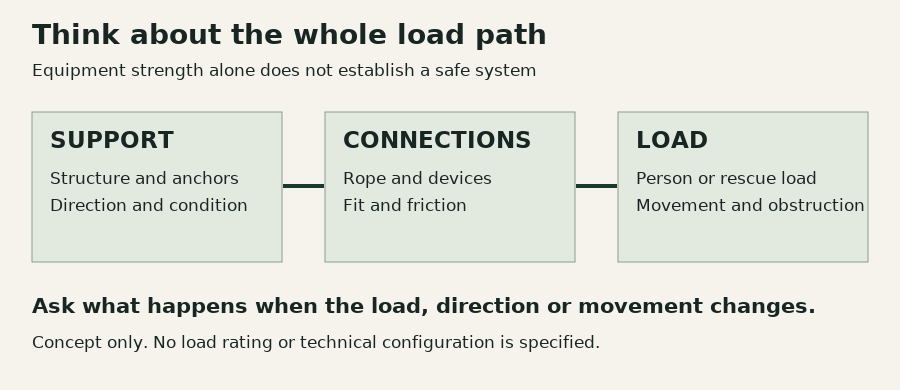
A system is a connected set of load paths, controls and people. Start at the casualty and follow each load path to its anchor. Identify what supports the load, what controls movement, what limits the consequences of a mistake and what could affect more than one line at once. Two ropes over the same unprotected sharp edge can share the same vulnerability.
A component strength marking describes a test or product property, not the complete rescue system. Geometry, connection orientation, edge contact, dynamic movement and device behaviour all matter. Calculations help explain a system, but the approved method must also be supported by compatible equipment, appropriate testing, inspection and operational limits.
The team calls a system redundant because it contains two ropes.
Check whether a single event could compromise both paths and whether the complete arrangement stays within the approved method.
Draw two independent-looking paths on a board, then add a shared edge or anchor feature. Ask the group to identify common failure points and propose a safer approved arrangement.
What does the second path protect against, and what does it share?
The edge is where rope direction, load support and communication often change together. A system that works in free space may become awkward as the casualty package reaches the transition. Plan the contact points, rope alignment, attendant position and protected arrival before rigging the movement system.
Edge protection needs monitoring. Ropes can shift as a load moves or the angle changes, and protection that was correctly placed may no longer cover the actual contact. Assign a competent person to observe the transition from a protected position and give them a reliable way to stop movement.
A raise runs smoothly until the casualty package reaches a sharp or obstructed edge.
Resolve the transition and its controls before committing the load.
On the approved inert trainer, trace the moving rope path and identify where protection may need adjustment. Rehearse the edge communication before movement.
Who can see the contact point that the operator cannot?
A lower-to-raise or raise-to-lower change alters the functions of devices and operators. The team must know what supports the load while controls are being changed, what captures unwanted movement and how the new operating state is checked.
The change should be planned before it is needed. Rope length, available travel, access to controls and equipment compatibility may limit the options. If the approved arrangement cannot make the change safely at the current position, a protected hold and revised plan are preferable to inventing a transition under load.
A casualty needs to move in the opposite direction, but the team has not planned the conversion.
Hold the load with the verified system and establish an approved transition.
Demonstrate the change with an inert load on the validated station. Explain active support at every stage and respond to a scripted communication interruption.
Can the team describe the current state without relying on the builder’s memory?
Readiness does not end at the pre-use check. Watch for changes in rope contact, connector orientation, control access and operator fatigue as the operation continues. An interruption or shift in position can create a different system from the one originally inspected.
A handover should describe the current load state, remaining rope and travel, known hazards, changed components and outstanding checks. The incoming operator must understand the controls before accepting responsibility. Equipment that is damaged or of uncertain condition is identified and removed from service through the provider’s process.
A new operator takes over while assuming the system still matches the initial briefing.
Make the current state explicit and verify the handover before resuming.
Use a paused inert scenario. Transfer the operator role with a structured verbal handover, then let the incoming operator identify a missing item of information.
What has changed since the first safety check?
A route profile is a simple side-view sketch of the casualty’s planned journey. Mark the starting position, major changes in terrain, the edge transition and the protected finish. Add the rope contact points and the places where operators can see the load. The sketch helps the team discuss the same route rather than different mental pictures.
Now mark where a knot, obstruction or change of direction could interrupt movement. For each point, explain the approved hold and how communication will reach the operator. A profile does not replace inspection; it reveals what needs inspection and makes a briefing easier to check.
The rigging team and edge team imagine different routes for the load.
Use a shared sketch and verified observations to agree the route.
Draw a profile from the training site, then walk through it with the instructor before rigging. Correct the sketch where observation contradicts it.
Which part of the route is least visible to the person controlling movement?
The vertical raise has gone smoothly. As the litter approaches the edge, the attendant reports reduced clearance and the team at the haul cannot see the contact point.
Retain control and use the agreed communication route. The edge changes the geometry and may change contact, clearance and the attendant’s position. A successful vertical raise does not prove that the next part will work.
Confirm who observes the transition and who authorises movement. Check that the approved edge plan fits the actual litter position and the available landing space.
If the situation differs from that plan, reassess before continuing. More effort is not a substitute for clearance, and pushing from an unprotected position can add a second casualty.
Defining success as “up to the edge” and leaving the movement onto the landing to improvisation.
The destination area is now occupied by equipment. Decide how to restore a safe landing without losing control of the load.
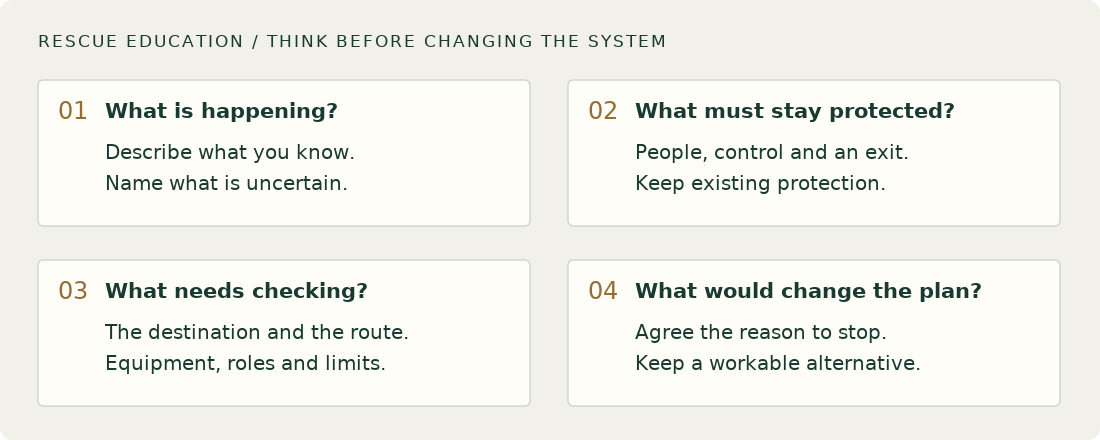
Answer in your own words before reading the explanations near the end of the handbook. These questions support revision; they do not replace practical assessment.
Explain your reasoning before checking the answer.
Explain your reasoning before checking the answer.
Explain your reasoning before checking the answer.
A controlled vertical training venue with verified anchors, safe edge access, adequate clearance and a rehearsed participant recovery plan. Provide a manufactured high directional where the approved syllabus requires one. Record actual assessed environments; do not infer natural-terrain competence from a tower alone.
Inspected rescue ropes and compatible control, ascent and backup devices
Suitable harnesses, helmets, footwear, gloves and environmental protection
Connectors, slings and anchor equipment with traceable inspection records
Rope and edge protection secured for expected movement
Casualty carrier, attachment system and training manikin or suitable test loads
Communications with an agreed backup signal and method
First-aid equipment and documented participant recovery resources
Manufactured high directional and compatible rigging with current instructions
Resources for protected casualty-access and transition exercises
Use only methods released for this programme version and current equipment instructions.
Verify anchors, compatibility, load paths, protection and recovery before loading.
Maintain prescribed protection during every transition; prove the receiving system before releasing the previous support.
No uncontrolled descent, dropped load or intentional shock loading is part of assessment.
Stop when safety, communication, environmental limits or recovery capability is compromised.
A serious safety intervention prevents a pass for that attempt; record the event, provide learning and reassess through a new documented attempt.
Do not trade patient protection for task speed.
Record each candidate’s actions and judgement; a successful team operation does not pass every member.
Name the responsible scheme and local operational authority; record venue parameters and evaluator approval in the operating annex. Scheme approval does not replace employer or jurisdictional authorisation.
For training with injury risk, arrange trained and equipped basic life-support cover and an effective emergency response. Any immediately dangerous exercise needs a separately approved rescue and intervention provision; never assume the teaching team alone is adequate.
Use these outcome references with your instructor. Explain your decisions and demonstrate the task under the stated conditions. A safe stop can show judgement; any required physical skill still needs its own observed demonstration.
RR2-A
Plan vertical movement using load-path and failure analysis, recoverability, appropriate anchors and equipment limitations. Explain the decision, perform the task without coaching at final assessment and identify conditions that require stopping or escalation. All critical safety controls apply; a correct final setup does not excuse an unsafe transition.
A proposed redirect changes the anchor loading and obstructs recovery. Challenge the plan.
Use the programme-approved venue, current method register, compatible inspected equipment and independent safety arrangements. The assessor states the task and scope before starting; clarification is allowed, coaching is not. Use dry planning or controlled test loads first; exposed application follows the approved technical plan.
Compare two rescue plans, identify resultant forces and justify the chosen contingency. Record the date, venue/conditions, method edition, observable actions, decision rationale and assessor. A knowledge answer may supplement but not replace required practical observation.
RR2-B
Construct and operate controlled vertical movement with the approved safety architecture and a recoverable stopping state. Explain the decision, perform the task without coaching at final assessment and identify conditions that require stopping or escalation. All critical safety controls apply; a correct final setup does not excuse an unsafe transition.
The preferred direction becomes unavailable after the load is committed. Stop and explain options.
Use the programme-approved venue, current method register, compatible inspected equipment and independent safety arrangements. The assessor states the task and scope before starting; clarification is allowed, coaching is not. Use dry planning or controlled test loads first; exposed application follows the approved technical plan.
Individual rigging and control of both directions; simulated casualty or approved test mass. Record the date, venue/conditions, method edition, observable actions, decision rationale and assessor. A knowledge answer may supplement but not replace required practical observation.
RR2-C
Change from raising to lowering and back while preserving casualty support and system integrity. Explain the decision, perform the task without coaching at final assessment and identify conditions that require stopping or escalation. All critical safety controls apply; a correct final setup does not excuse an unsafe transition.
The casualty must move back to a safe landing rather than continue. Change mode under control.
Use the programme-approved venue, current method register, compatible inspected equipment and independent safety arrangements. The assessor states the task and scope before starting; clarification is allowed, coaching is not. Use dry planning or controlled test loads first; exposed application follows the approved technical plan.
Observed loaded transitions with explanations of the active support and backup at each stage. Record the date, venue/conditions, method edition, observable actions, decision rationale and assessor. A knowledge answer may supplement but not replace required practical observation.
RR2-D
Negotiate a knot in personal movement and in rescue load systems without abandoning prescribed protection. Explain the decision, perform the task without coaching at final assessment and identify conditions that require stopping or escalation. All critical safety controls apply; a correct final setup does not excuse an unsafe transition.
A knot will arrive at a control device during an evacuation. Plan the transition before it reaches the device.
Use the programme-approved venue, current method register, compatible inspected equipment and independent safety arrangements. The assessor states the task and scope before starting; clarification is allowed, coaching is not. Use dry planning or controlled test loads first; exposed application follows the approved technical plan.
Separate individual evidence for ascent, descent, raise and lower transitions. Record the date, venue/conditions, method edition, observable actions, decision rationale and assessor. A knowledge answer may supplement but not replace required practical observation.
RR2-E
Rig casualty and attendant attachments and manage a carrier across an edge with controlled orientation and continuous protection. Explain the decision, perform the task without coaching at final assessment and identify conditions that require stopping or escalation. All critical safety controls apply; a correct final setup does not excuse an unsafe transition.
The carrier catches on the edge and the attendant loses useful positioning. Stop and reset safely.
Use the programme-approved venue, current method register, compatible inspected equipment and independent safety arrangements. The assessor states the task and scope before starting; clarification is allowed, coaching is not. Use dry planning or controlled test loads first; exposed application follows the approved technical plan.
Candidate leads an edge transition and separately demonstrates personal ascent and descent edge negotiation. Record the date, venue/conditions, method edition, observable actions, decision rationale and assessor. A knowledge answer may supplement but not replace required practical observation.
RR2-F
Use a manufactured high directional in an approved configuration and explain how loading and anchorage maintain its stability. Explain the decision, perform the task without coaching at final assessment and identify conditions that require stopping or escalation. All critical safety controls apply; a correct final setup does not excuse an unsafe transition.
Moving the load changes the high directional resultant. Explain the consequence before operating.
Use the programme-approved venue, current method register, compatible inspected equipment and independent safety arrangements. The assessor states the task and scope before starting; clarification is allowed, coaching is not. Use dry planning or controlled test loads first; exposed application follows the approved technical plan.
Plan, rig, check and observe a controlled change in load direction; use current manufacturer documentation. Record the date, venue/conditions, method edition, observable actions, decision rationale and assessor. A knowledge answer may supplement but not replace required practical observation.
RR2-G
Plan a protected approach to a simulated unsecured casualty and transfer them to a controlled rescue system. Explain the decision, perform the task without coaching at final assessment and identify conditions that require stopping or escalation. All critical safety controls apply; a correct final setup does not excuse an unsafe transition.
The casualty attachment is not where expected. Reassess access, restraint and transfer rather than improvise under load.
Use the programme-approved venue, current method register, compatible inspected equipment and independent safety arrangements. The assessor states the task and scope before starting; clarification is allowed, coaching is not. Use dry planning or controlled test loads first; exposed application follows the approved technical plan.
Assessed rescue using a protected manikin; account for total load, patient attachment and evacuation route. Record the date, venue/conditions, method edition, observable actions, decision rationale and assessor. A knowledge answer may supplement but not replace required practical observation.
RR2-H
Evaluate a retrievable system and an improvised casualty attachment without creating a premature-release or medical hazard. Explain the decision, perform the task without coaching at final assessment and identify conditions that require stopping or escalation. All critical safety controls apply; a correct final setup does not excuse an unsafe transition.
A proposed retrievable arrangement could release before everyone is safe. Identify the fault in a dry setup.
Use the programme-approved venue, current method register, compatible inspected equipment and independent safety arrangements. The assessor states the task and scope before starting; clarification is allowed, coaching is not. Use dry planning or controlled test loads first; exposed application follows the approved technical plan.
Dry or low-consequence demonstration and explanation of limitations; no improvised attachment used for other live-load assessment. Record the date, venue/conditions, method edition, observable actions, decision rationale and assessor. A knowledge answer may supplement but not replace required practical observation.
RR2-I
Work as a technical team member across a vertical rescue with a changed condition and a recoverable contingency. Explain the decision, perform the task without coaching at final assessment and identify conditions that require stopping or escalation. All critical safety controls apply; a correct final setup does not excuse an unsafe transition.
A team member gives inconsistent status information during a vertical rescue. Re-establish a verified plan.
Use the programme-approved venue, current method register, compatible inspected equipment and independent safety arrangements. The assessor states the task and scope before starting; clarification is allowed, coaching is not. Use dry planning or controlled test loads first; exposed application follows the approved technical plan.
Individual ratings across planning, operations, communication, patient protection and safe termination. Record the date, venue/conditions, method edition, observable actions, decision rationale and assessor. A knowledge answer may supplement but not replace required practical observation.
RR2-J
Monitor equipment, personnel and patient exposure throughout a vertical operation; withdraw or quarantine a suspect component and hand over an accurate system status. Explain the decision, perform the task without coaching at final assessment and identify conditions that require stopping or escalation. All critical safety controls apply; a correct final setup does not excuse an unsafe transition.
A rope section is reported damaged during the task. Stop, preserve control and manage the equipment decision.
Use the programme-approved venue, current method register, compatible inspected equipment and independent safety arrangements. The assessor states the task and scope before starting; clarification is allowed, coaching is not. Use dry planning or controlled test loads first; exposed application follows the approved technical plan.
Scenario inject involving equipment damage or rescuer fatigue; log the action and transfer responsibility clearly. Record the date, venue/conditions, method edition, observable actions, decision rationale and assessor. A knowledge answer may supplement but not replace required practical observation.
Start with the information in the problem. State your assumptions, choose a safe objective and explain what would make you change the plan. Apply technical skills only in the approved supervised exercise.
Recover a simulated casualty using a planned vertical system and controlled carrier transition.
Individual rigging, edge management, command, patient/attendant protection and controlled movement.
Use approved manikin/load, edge protection and dedicated rescue cover; validate system before operation.
The intended landing is unavailable after the simulated load is committed.
Stop, reassess, change mode under control, communicate and recover to a safe location.
Do not remove safeguards to simulate failure; the assessor injects a scenario change within the approved envelope.
A knot or edge obstacle requires a protected personal or load-system transition.
Separate evidence for relevant movement directions; maintain and explain protection throughout.
Use tested training configuration, manageable load and independent recovery; no deliberate device damage or real rope defect.
The assessor records your individual decisions and practical performance. The ratings are I for independent and safe, C for coached or incomplete, N for not observed and S for a safety intervention. A missing or unsafe outcome cannot be balanced by a strong performance elsewhere.
The course instructor records teaching and practice. A separately approved assessor records competence, and the scheme checks the certification decision. You can ask for the reasons for a result and use the appeal route if you disagree.
If evidence is incomplete, you receive the observed gaps and a targeted practice plan. Reassessment checks the affected skills and their interaction in a scenario. Use the private support route for an appeal or a correction to your record.
After a recorded pass, submit the short course evaluation. Critical feedback and positive feedback have exactly the same effect on eligibility. Your certificate includes the assessment date, instructor, programme edition and a verification code. An award image alone is not a verifiable credential.
Keep a short record for each practice session. Do not enter unnecessary medical details or another person’s private information. A practice log supports learning; the course record and award remain in the portal.
Date and location
Skill or outcome reference
Conditions and equipment or method reference
What I did and why
Feedback and any intervention
What I will practise next and with whom
The transition has to preserve control and protection. Waiting until the system is stuck can leave the team with fewer workable options.
The actual system state, who controls it, relevant limits, current hazards and the next authorised action. The receiving person must confirm understanding.
Yes. A change in direction or load can change its stability and reactions. Check the complete approved arrangement for the new condition.
Edge transition — The part of the movement where the load crosses the boundary between the face and the landing.
Clearance — Space needed for the people, equipment and movement throughout the operation.
System state — What is connected, loaded, controlling movement and available as protection at a particular time.
High directional — A supported elevated point used to route a rope; its stability is part of the complete system.
Use the current instructions for the exact model of equipment on your course. Check its intended use, compatible components, inspection points and operating limits. A similar-looking device may behave differently.
Ask your instructor to show how the approved method sheet and equipment instructions fit together. Report anything that is unclear before practical use. The references below are selected primary sources; they do not certify this course.
Petzl Professional Catalogue Technical Rescue 2026
Corroborates that a labelled ratio is not measured system performance; no product configurations or capacities adopted.