
1. What does a nominal 3:1 ratio tell you?
Explain your reasoning before checking the answer.
RR1 / LEARNER HANDBOOK / EDITION 0.2
A team-member award for protected personal rope movement and casualty evacuation on inclined terrain, under a competent team leader and within the recorded environment.
Draft handbook for review. This course is not yet open.
Our aim is to make high-quality rescue education more accessible. This handbook helps you understand the decisions behind the skills, prepare for your course and revise afterwards.
Read the explanations, try the worked case and answer the questions before checking the reasoning. Bring uncertainties to your instructor. Practical learning uses the approved methods and the actual equipment supplied for your course.
Technical review edition 0.2. The course is not yet open. Practical method sheets, equipment configurations and assessment stations still require technical approval and pilot testing.
A team-member award for protected personal rope movement and casualty evacuation on inclined terrain, under a competent team leader and within the recorded environment.
Adults aged 18 or over. No previous rope rescue award required. The instructor verifies capacity to participate in the specified practical tasks, appropriate personal preparation and a plan for reasonable adjustments. Current first aid/CPR relevant to the intended role is required before certification; this programme does not award clinical competence.
Read the student pack and scope limits; identify the local response route and communication limitations.
Bring required inspected personal equipment or arrange provider equipment in advance.
Discuss adjustments and ability to participate privately with the provider; avoid uploading unnecessary medical details to the registry.
Review prerequisite skills and current first aid/CPR; submit qualification references where entry requires them.
Expect flexible practice time and individual evidence for every outcome. Ask to stop whenever protection or understanding is uncertain.
Understand your own role in a rope rescue system and make your checks and actions visible to the team.
Before the course, read the explanations and note the terms you do not know. During the course, connect each explanation to the supervised demonstration. Afterwards, use the questions and your practice record to identify what needs refreshing.
A rescue plan describes a change from the present situation to a safer one. Begin by saying what must be protected now, where the person should finish, and what must remain true while they move. The destination may be a bank, a stance, a protected edge or a stable place to wait for help. Choosing a destination before a technique makes it easier to notice a plan that solves one difficulty but creates another.
Separate what you have observed from what you assume. A rope disappearing over an edge does not prove its condition or attachment. A quiet patch of water does not prove a safe exit. State the missing information and decide whether it can be checked without exposing another person. If it cannot, the plan needs a different route or more capable assistance.
The group begins building the first familiar system before anyone checks the landing or exit.
Describe the destination, route, protection and fallback in plain language before selecting equipment.
Use a photograph or tabletop scene. Each learner marks the present protected position, the proposed destination, two uncertainties and the point at which the plan must stop. No live exposure is needed.
Which part of your plan is an observation, and which part is still an assumption?
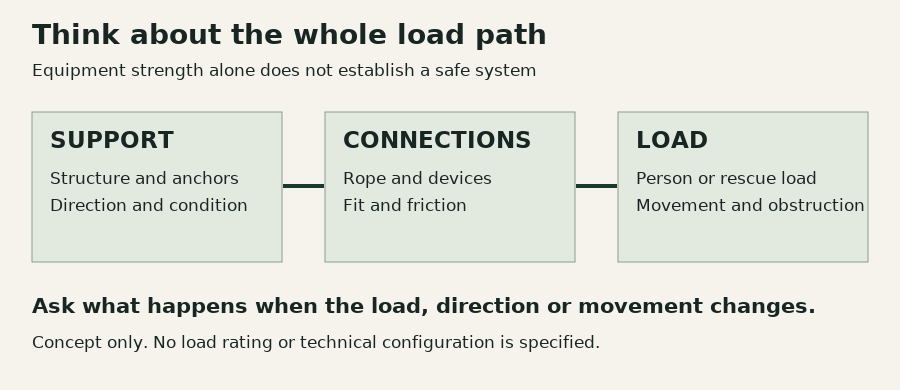
Knowing how a system was assembled can make an error harder to see: the builder tends to see the intended arrangement. A competent second person should follow the actual connections, rope route and device orientation. The check asks whether the assembled arrangement matches the approved method, whether components are compatible and whether the system can be operated and recovered.
A check is time-specific. Moving an anchor, changing a device mode, adding a load or altering the rope path can invalidate it. Say what changed and obtain the necessary recheck before movement resumes. Inspection is a practical skill with a defined scope; a second person who does not understand the system cannot provide a meaningful independent check.
A checked system is rearranged to make room, and the team assumes the earlier check still applies.
Treat a meaningful change as a new decision point. Identify the affected protection and recheck it.
On an unloaded trainer, the instructor changes one benign configuration detail. Learners explain which part of the earlier inspection is now stale. Do not insert hidden defects into a live safety system.
What would make you ask for a complete recheck rather than a local one?
A message succeeds when the intended person understands the intended action. Names, brief instructions and a confirmation reduce ambiguity, especially when people cannot see the same part of the incident. The team should agree who coordinates movement, how anybody can call a stop and what happens when a message is lost.
Repeating a message is useful only if the sender listens and corrects a misunderstanding. Silence, a nod from someone else or a remembered sequence is not confirmation. Before practical work, test the actual communication method from the positions people will occupy. Wind, water noise, cliff geometry and failed batteries can defeat a method that worked at the briefing.
One person hears lower while another hears hold.
Stop the affected movement and restore a shared understanding through the agreed fallback.
Use a tabletop load marker. A sender, operator and observer run a short movement sequence with one deliberately unclear message. The marker must stay still until the instruction is confirmed.
How will a new team member know which signal stops the exercise?
A system is a connected set of load paths, controls and people. Start at the casualty and follow each load path to its anchor. Identify what supports the load, what controls movement, what limits the consequences of a mistake and what could affect more than one line at once. Two ropes over the same unprotected sharp edge can share the same vulnerability.
A component strength marking describes a test or product property, not the complete rescue system. Geometry, connection orientation, edge contact, dynamic movement and device behaviour all matter. Calculations help explain a system, but the approved method must also be supported by compatible equipment, appropriate testing, inspection and operational limits.
The team calls a system redundant because it contains two ropes.
Check whether a single event could compromise both paths and whether the complete arrangement stays within the approved method.
Draw two independent-looking paths on a board, then add a shared edge or anchor feature. Ask the group to identify common failure points and propose a safer approved arrangement.
What does the second path protect against, and what does it share?
The working position must be suitable before you begin handling the rescue system. Access routes, unstable ground, loose equipment and an exposed edge can endanger someone who is concentrating on a knot or device. Establish the work area and the personal protection method before the technical task starts.
Protection has an operating envelope. Changing body position, line length or attachment can turn a restrained task into one with fall potential. Explain the intended movement and the limiting feature of the setup. If you cannot reach safely within the approved arrangement, pause and have the position redesigned rather than stretching or improvising.
An operator steps beyond the protected work area to improve their view.
Keep personal protection effective while obtaining information through an approved viewing or communication arrangement.
Walk the marked training site with the instructor. Identify safe waiting, equipment and working areas, then rehearse access on an unloaded station.
Which movement would take you outside the protection you have described?
A slope rescue combines rope control with contact between the load and terrain. That contact can change abruptly at a step, loose patch or edge. Do not assume that a load is light merely because several people can currently support it on the ground.
Plan the whole route and agree how the team will stop, hold and communicate. The casualty package, attendants and rope system must remain suitable as support from the terrain changes. Movement should be coordinated rather than produced by individual people lifting or pulling at different times.
A litter moves easily until a step removes much of its ground support.
Anticipate transitions and establish the approved control before reaching them.
Use an inert load on the validated slope station. Learners identify the next change in terrain and brief the hold and movement sequence.
Where will the rope system have to do more work than it is doing now?
Team rescue competence includes both performing a task and communicating its state. If you operate a control, report what is ready, what remains unchecked and what would cause you to stop. A quiet team can conceal uncertainty even when the equipment appears orderly.
After practice, record an observable action and its result. “Helped with the rescue” is not enough to show competence. Describe your role, the conditions, the checks you made and how you responded to a change. Identify one specific skill to repeat so that debriefing leads to useful practice.
The team completes the exercise but cannot explain who checked or controlled a critical stage.
Make responsibility and evidence visible through briefings, confirmations and individual records.
Rotate roles in the approved scenario. Each learner gives a short handover and records one decision, one check and one improvement.
What evidence shows your own competence rather than the success of the group?
An ideal 3 to 1 hauling system trades distance for force: in the simplest model, three units of rope travel produce one unit of load travel. It does not create energy. If the model load moves one metre, the hauling end travels three metres; a real system may require additional travel for stretch, resets and other effects.
This model explains why adding mechanical advantage can make a task slower or exceed the available working space. Real effort also depends on friction and component behaviour, so the ideal number is not a prediction of measured performance. Use the simplest approved arrangement that performs the task within its limits, and investigate unexpected resistance rather than assuming the ratio guarantees success.
A learner expects a larger ideal ratio to improve every part of the operation.
Compare force, rope travel, available space and resets together.
Move a light tabletop model through a marked distance and measure hauling-end travel. Discuss why this model does not establish the capacity of an operational system.
What is gained and what is spent when mechanical advantage increases?
On an approved training system, movement was steady but now requires noticeably more effort. The team suggests adding another person to pull.
Call the agreed stop and retain load control. An unexpected change is information about the system, not an invitation to apply more force.
Report what you observed: where movement stopped, when the resistance changed and what was happening at the edge. Let the nominated controller coordinate the inspection rather than having several people alter the system.
Use an unloaded tabletop model to explore the force and distance trade. An ideal 3:1 system requires three units of haul travel for one unit of load travel; real friction and resetting reduce useful performance. This model explains behaviour, not the capacity of a rescue system.
Judging the safety or capacity of the whole system from how easy it feels to pull.
The obstruction is cleared. Explain why the system still needs a coordinated check before movement resumes.
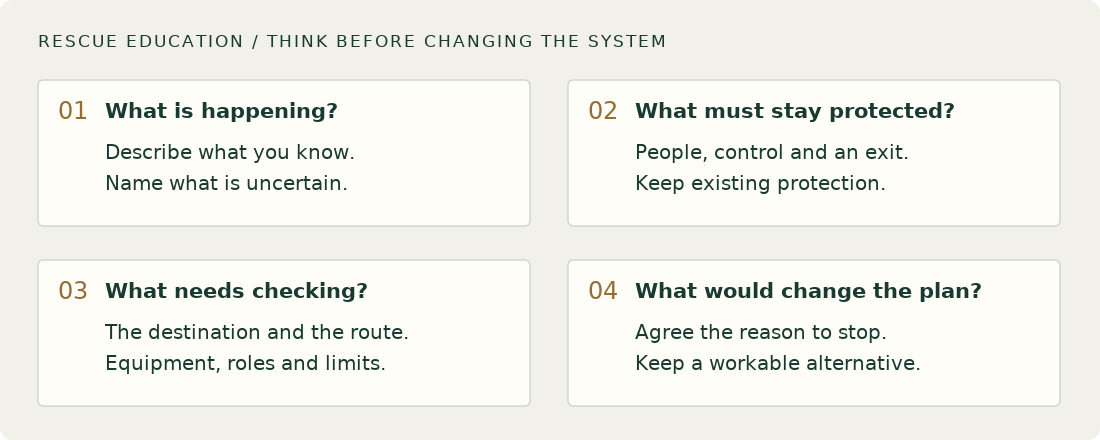
Answer in your own words before reading the explanations near the end of the handbook. These questions support revision; they do not replace practical assessment.
Explain your reasoning before checking the answer.
Explain your reasoning before checking the answer.
Explain your reasoning before checking the answer.
A controlled training venue providing a verified safe slope and a protected personal-rope installation. Record access, anchors, edge hazards, rescue cover, environmental limits and evacuation. A safe classroom/ground setting is used for early learning. Exposed practice begins only after checks and low-consequence competence.
Inspected rescue ropes and compatible control, ascent and backup devices
Suitable harnesses, helmets, footwear, gloves and environmental protection
Connectors, slings and anchor equipment with traceable inspection records
Rope and edge protection secured for expected movement
Casualty carrier, attachment system and training manikin or suitable test loads
Communications with an agreed backup signal and method
First-aid equipment and documented participant recovery resources
Use only methods released for this programme version and current equipment instructions.
Verify anchors, compatibility, load paths, protection and recovery before loading.
Maintain prescribed protection during every transition; prove the receiving system before releasing the previous support.
No uncontrolled descent, dropped load or intentional shock loading is part of assessment.
Stop when safety, communication, environmental limits or recovery capability is compromised.
A serious safety intervention prevents a pass for that attempt; record the event, provide learning and reassess through a new documented attempt.
Do not trade patient protection for task speed.
Record each candidate’s actions and judgement; a successful team operation does not pass every member.
Name the responsible scheme and local operational authority; record venue parameters and evaluator approval in the operating annex. Scheme approval does not replace employer or jurisdictional authorisation.
For training with injury risk, arrange trained and equipped basic life-support cover and an effective emergency response. Any immediately dangerous exercise needs a separately approved rescue and intervention provision; never assume the teaching team alone is adequate.
Use these outcome references with your instructor. Explain your decisions and demonstrate the task under the stated conditions. A safe stop can show judgement; any required physical skill still needs its own observed demonstration.
RR1-A
Recognise the incident limits, establish safe working areas and explain the team response and escalation plan. Explain the decision, perform the task without coaching at final assessment and identify conditions that require stopping or escalation. All critical safety controls apply; a correct final setup does not excuse an unsafe transition.
The easiest access line crosses an area of loose rock. Decide what changes before anyone enters.
Use the programme-approved venue, current method register, compatible inspected equipment and independent safety arrangements. The assessor states the task and scope before starting; clarification is allowed, coaching is not. Progress from dry/ground practice to the approved protected environment.
Brief a changed-conditions scenario; identify a safe stop and call-for-help decision. Record the date, venue/conditions, method edition, observable actions, decision rationale and assessor. A knowledge answer may supplement but not replace required practical observation.
RR1-B
Select compatible equipment for the assigned task, inspect it, fit personal protection and remove suspect items from service. Explain the decision, perform the task without coaching at final assessment and identify conditions that require stopping or escalation. All critical safety controls apply; a correct final setup does not excuse an unsafe transition.
A familiar device is presented with a rope outside its documented compatibility. Decide and explain.
Use the programme-approved venue, current method register, compatible inspected equipment and independent safety arrangements. The assessor states the task and scope before starting; clarification is allowed, coaching is not. Progress from dry/ground practice to the approved protected environment.
Individual pre-use inspection and function checks with a deliberately unsuitable item. Record the date, venue/conditions, method edition, observable actions, decision rationale and assessor. A knowledge answer may supplement but not replace required practical observation.
RR1-C
Trace the load path, distinguish strength from working limits and explain how friction, angles and unintended movement affect the chosen system. Explain the decision, perform the task without coaching at final assessment and identify conditions that require stopping or escalation. All critical safety controls apply; a correct final setup does not excuse an unsafe transition.
A haul feels harder after a redirect is added. Explain why extra pulling may be the wrong response.
Use the programme-approved venue, current method register, compatible inspected equipment and independent safety arrangements. The assessor states the task and scope before starting; clarification is allowed, coaching is not. Progress from dry/ground practice to the approved protected environment.
Explain a rigging model and identify an unsafe change before loading. Record the date, venue/conditions, method edition, observable actions, decision rationale and assessor. A knowledge answer may supplement but not replace required practical observation.
RR1-D
Use a shared communication plan and closed-loop commands; stop safely when a command is lost or ambiguous. Explain the decision, perform the task without coaching at final assessment and identify conditions that require stopping or escalation. All critical safety controls apply; a correct final setup does not excuse an unsafe transition.
The operator receives an unclear command while the casualty is out of sight. Show the response.
Use the programme-approved venue, current method register, compatible inspected equipment and independent safety arrangements. The assessor states the task and scope before starting; clarification is allowed, coaching is not. Progress from dry/ground practice to the approved protected environment.
Observed role rotation in a noisy or obstructed-view simulation. Record the date, venue/conditions, method edition, observable actions, decision rationale and assessor. A knowledge answer may supplement but not replace required practical observation.
RR1-E
Choose, construct and check suitable connections and single or multiple anchor arrangements for the planned load and direction. Explain the decision, perform the task without coaching at final assessment and identify conditions that require stopping or escalation. All critical safety controls apply; a correct final setup does not excuse an unsafe transition.
The intended loading direction changes. Reassess the arrangement before committing a load.
Use the programme-approved venue, current method register, compatible inspected equipment and independent safety arrangements. The assessor states the task and scope before starting; clarification is allowed, coaching is not. Progress from dry/ground practice to the approved protected environment.
Individually build and justify two different anchor situations; explain the effect of a component loss. Record the date, venue/conditions, method edition, observable actions, decision rationale and assessor. A knowledge answer may supplement but not replace required practical observation.
RR1-F
Manage rope contact and rescuer movement so neither a person nor a critical component is exposed to an uncontrolled edge hazard. Explain the decision, perform the task without coaching at final assessment and identify conditions that require stopping or escalation. All critical safety controls apply; a correct final setup does not excuse an unsafe transition.
Protection shifts after tension is applied. Identify, stop and remedy the problem safely.
Use the programme-approved venue, current method register, compatible inspected equipment and independent safety arrangements. The assessor states the task and scope before starting; clarification is allowed, coaching is not. Progress from dry/ground practice to the approved protected environment.
Set up an edge workstation and recheck it after the loading direction changes. Record the date, venue/conditions, method edition, observable actions, decision rationale and assessor. A knowledge answer may supplement but not replace required practical observation.
RR1-G
Ascend, descend, stop and change between movement modes while retaining the prescribed protection and checking each new configuration. Explain the decision, perform the task without coaching at final assessment and identify conditions that require stopping or escalation. All critical safety controls apply; a correct final setup does not excuse an unsafe transition.
You need to reverse direction while suspended. Explain the protected transition and checks.
Use the programme-approved venue, current method register, compatible inspected equipment and independent safety arrangements. The assessor states the task and scope before starting; clarification is allowed, coaching is not. Progress from dry/ground practice to the approved protected environment.
Observed individual ascent/descent/changeovers in an approved protected training installation. Record the date, venue/conditions, method edition, observable actions, decision rationale and assessor. A knowledge answer may supplement but not replace required practical observation.
RR1-H
Recognise a simulated obstruction or inoperable device and regain a controlled position using an approved self-rescue method. Explain the decision, perform the task without coaching at final assessment and identify conditions that require stopping or escalation. All critical safety controls apply; a correct final setup does not excuse an unsafe transition.
A simulated jam prevents normal descent. Establish a stable position and select a recovery method.
Use the programme-approved venue, current method register, compatible inspected equipment and independent safety arrangements. The assessor states the task and scope before starting; clarification is allowed, coaching is not. Progress from dry/ground practice to the approved protected environment.
Controlled low-consequence simulation with independent protection; candidate explains each transition. Record the date, venue/conditions, method edition, observable actions, decision rationale and assessor. A knowledge answer may supplement but not replace required practical observation.
RR1-I
Operate an independently functioning safety system and preserve control during starting, stopping and resuming movement. Explain the decision, perform the task without coaching at final assessment and identify conditions that require stopping or escalation. All critical safety controls apply; a correct final setup does not excuse an unsafe transition.
The team stops unexpectedly and later resumes. Show how control and communication are maintained.
Use the programme-approved venue, current method register, compatible inspected equipment and independent safety arrangements. The assessor states the task and scope before starting; clarification is allowed, coaching is not. Progress from dry/ground practice to the approved protected environment.
Individual control of a test load through a slope operation, including an unannounced stop command. Record the date, venue/conditions, method edition, observable actions, decision rationale and assessor. A knowledge answer may supplement but not replace required practical observation.
RR1-J
Build and operate suitable lowering and raising arrangements; explain progress capture, holding and overload prevention. Explain the decision, perform the task without coaching at final assessment and identify conditions that require stopping or escalation. All critical safety controls apply; a correct final setup does not excuse an unsafe transition.
The available hauling space is shorter than planned. Adapt the arrangement within the approved method.
Use the programme-approved venue, current method register, compatible inspected equipment and independent safety arrangements. The assessor states the task and scope before starting; clarification is allowed, coaching is not. Progress from dry/ground practice to the approved protected environment.
Each candidate rigs and controls both directions with a simulated casualty, rather than receiving credit solely for hauling. Record the date, venue/conditions, method edition, observable actions, decision rationale and assessor. A knowledge answer may supplement but not replace required practical observation.
RR1-K
Prepare and attach the casualty carrier and attendants for the planned slope movement while protecting airway access, comfort and security. Explain the decision, perform the task without coaching at final assessment and identify conditions that require stopping or escalation. All critical safety controls apply; a correct final setup does not excuse an unsafe transition.
A casualty reports discomfort and an attendant cannot reach their task. Reassess the rigging and plan.
Use the programme-approved venue, current method register, compatible inspected equipment and independent safety arrangements. The assessor states the task and scope before starting; clarification is allowed, coaching is not. Progress from dry/ground practice to the approved protected environment.
Package a training manikin, explain casualty-care boundaries, check attachments and monitor during a scenario. Record the date, venue/conditions, method edition, observable actions, decision rationale and assessor. A knowledge answer may supplement but not replace required practical observation.
RR1-L
Perform assigned roles in a slope evacuation, adapt to a changing hazard and complete handover and debrief. Explain the decision, perform the task without coaching at final assessment and identify conditions that require stopping or escalation. All critical safety controls apply; a correct final setup does not excuse an unsafe transition.
The team is ready, but new information makes the proposed slope route unacceptable. Change the plan.
Use the programme-approved venue, current method register, compatible inspected equipment and independent safety arrangements. The assessor states the task and scope before starting; clarification is allowed, coaching is not. Progress from dry/ground practice to the approved protected environment.
Individual evidence recorded within a team scenario, plus a separate no-go/escalation decision. Record the date, venue/conditions, method edition, observable actions, decision rationale and assessor. A knowledge answer may supplement but not replace required practical observation.
Start with the information in the problem. State your assumptions, choose a safe objective and explain what would make you change the plan. Apply technical skills only in the approved supervised exercise.
A casualty cannot walk up a defined slope. The party needs a controlled evacuation and a clear handover.
Scene plan; individual anchors and checks; casualty packaging; each candidate controls raising/lowering or another separately assessed role.
Use a manikin/test load, controlled slope and secured working area; assign dedicated safety supervision.
A training obstruction stops normal movement on a protected installation.
Identify the problem, establish a stable state, explain the support path and recover with an approved method.
Use low-consequence installation and an independent recovery system; no deliberately induced uncontrolled fall.
A new hazard or weather message invalidates the intended evacuation route.
Stop command, revised hazard assessment, safe alternative or escalation, effective team briefing.
Inject information verbally; do not introduce a real hazard. A well-justified no-go is a valid competent decision.
The assessor records your individual decisions and practical performance. The ratings are I for independent and safe, C for coached or incomplete, N for not observed and S for a safety intervention. A missing or unsafe outcome cannot be balanced by a strong performance elsewhere.
The course instructor records teaching and practice. A separately approved assessor records competence, and the scheme checks the certification decision. You can ask for the reasons for a result and use the appeal route if you disagree.
If evidence is incomplete, you receive the observed gaps and a targeted practice plan. Reassessment checks the affected skills and their interaction in a scenario. Use the private support route for an appeal or a correction to your record.
After a recorded pass, submit the short course evaluation. Critical feedback and positive feedback have exactly the same effect on eligibility. Your certificate includes the assessment date, instructor, programme edition and a verification code. An award image alone is not a verifiable credential.
Keep a short record for each practice session. Do not enter unnecessary medical details or another person’s private information. A practice log supports learning; the course record and award remain in the portal.
Date and location
Skill or outcome reference
Conditions and equipment or method reference
What I did and why
Feedback and any intervention
What I will practise next and with whom
It describes an ideal force and travel relationship for that arrangement. It does not establish actual efficiency, component loading or safe working capacity.
A remembered drawing can hide a misconnection or unexpected contact. The installed arrangement is what carries the load.
An observer needs evidence of your own required checks, actions and decisions. Team success alone does not show who could perform each task independently.
Mechanical advantage — The relationship between input force and useful output force in a system.
Efficiency — How much of the ideal performance remains after losses such as friction.
Load path — The route through which forces pass between the load and its supports.
Progress capture — A function that retains gained movement, within the limits of the approved arrangement.
Use the current instructions for the exact model of equipment on your course. Check its intended use, compatible components, inspection points and operating limits. A similar-looking device may behave differently.
Ask your instructor to show how the approved method sheet and equipment instructions fit together. Report anything that is unclear before practical use. The references below are selected primary sources; they do not certify this course.
Petzl Professional Catalogue Technical Rescue 2026
Corroborates that a labelled ratio is not measured system performance; no product configurations or capacities adopted.