
1. Does a second rope always provide independent protection?
Explain your reasoning before checking the answer.
CR3 / LEARNER HANDBOOK / EDITION 0.2
Coordinate a small party, manage a simulated incapacitated climber and revise a plan as equipment, rope path or conditions change.
Draft handbook for review. This course is not yet open.
Our aim is to make high-quality rescue education more accessible. This handbook helps you understand the decisions behind the skills, prepare for your course and revise afterwards.
Read the explanations, try the worked case and answer the questions before checking the reasoning. Bring uncertainties to your instructor. Practical learning uses the approved methods and the actual equipment supplied for your course.
Technical review edition 0.2. The course is not yet open. Practical method sheets, equipment configurations and assessment stations still require technical approval and pilot testing.
Coordinate a small party, manage a simulated incapacitated climber and revise a plan as equipment, rope path or conditions change.
CR2 or an observed equivalent, recent independent multipitch experience and current outdoor first aid suitable for the intended remote rock setting.
Coordinate a small party when casualty capability, rope condition and the intended rescue route can change.
Before the course, read the explanations and note the terms you do not know. During the course, connect each explanation to the supervised demonstration. Afterwards, use the questions and your practice record to identify what needs refreshing.
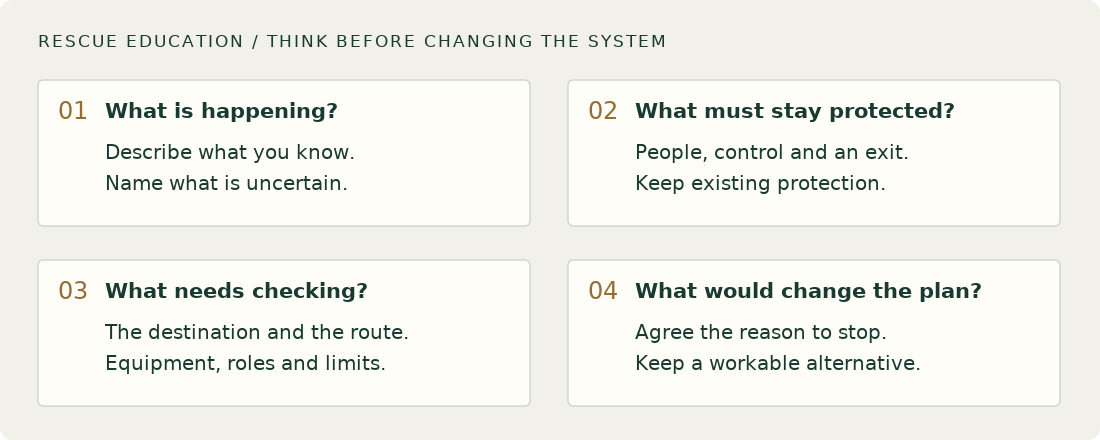
A rescue plan describes a change from the present situation to a safer one. Begin by saying what must be protected now, where the person should finish, and what must remain true while they move. The destination may be a bank, a stance, a protected edge or a stable place to wait for help. Choosing a destination before a technique makes it easier to notice a plan that solves one difficulty but creates another.
Separate what you have observed from what you assume. A rope disappearing over an edge does not prove its condition or attachment. A quiet patch of water does not prove a safe exit. State the missing information and decide whether it can be checked without exposing another person. If it cannot, the plan needs a different route or more capable assistance.
The group begins building the first familiar system before anyone checks the landing or exit.
Describe the destination, route, protection and fallback in plain language before selecting equipment.
Use a photograph or tabletop scene. Each learner marks the present protected position, the proposed destination, two uncertainties and the point at which the plan must stop. No live exposure is needed.
Which part of your plan is an observation, and which part is still an assumption?
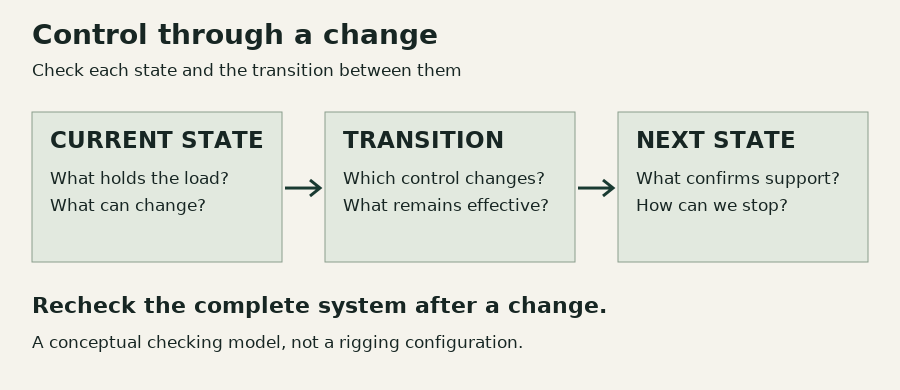
Knowing how a system was assembled can make an error harder to see: the builder tends to see the intended arrangement. A competent second person should follow the actual connections, rope route and device orientation. The check asks whether the assembled arrangement matches the approved method, whether components are compatible and whether the system can be operated and recovered.
A check is time-specific. Moving an anchor, changing a device mode, adding a load or altering the rope path can invalidate it. Say what changed and obtain the necessary recheck before movement resumes. Inspection is a practical skill with a defined scope; a second person who does not understand the system cannot provide a meaningful independent check.
A checked system is rearranged to make room, and the team assumes the earlier check still applies.
Treat a meaningful change as a new decision point. Identify the affected protection and recheck it.
On an unloaded trainer, the instructor changes one benign configuration detail. Learners explain which part of the earlier inspection is now stale. Do not insert hidden defects into a live safety system.
What would make you ask for a complete recheck rather than a local one?
A message succeeds when the intended person understands the intended action. Names, brief instructions and a confirmation reduce ambiguity, especially when people cannot see the same part of the incident. The team should agree who coordinates movement, how anybody can call a stop and what happens when a message is lost.
Repeating a message is useful only if the sender listens and corrects a misunderstanding. Silence, a nod from someone else or a remembered sequence is not confirmation. Before practical work, test the actual communication method from the positions people will occupy. Wind, water noise, cliff geometry and failed batteries can defeat a method that worked at the briefing.
One person hears lower while another hears hold.
Stop the affected movement and restore a shared understanding through the agreed fallback.
Use a tabletop load marker. A sender, operator and observer run a short movement sequence with one deliberately unclear message. The marker must stay still until the instruction is confirmed.
How will a new team member know which signal stops the exercise?
Many climbing problems begin as manageable interruptions: fear, fatigue, a missed stance or uncertainty about a command. A calm conversation and a verified ordinary lower may resolve the problem with fewer changes than a rescue system. Ask what the climber can do, check the route to the landing and keep the belayer in control while deciding.
Climbing equipment works in particular modes. A device that assists braking is not permission to abandon the required brake-hand position, and a method demonstrated with one model may not transfer to another. The instructor must identify the exact model, compatible rope and approved procedure. Learn the purpose of each action as well as its sequence.
A group starts an elaborate rescue when the climber is responsive and a normal safe lower may be possible.
First verify whether the familiar controlled method reaches a safe destination.
Discuss three route photographs with different landing and communication conditions. Explain when an ordinary lower is suitable and when it must wait.
Which uncertainty would make you stop a normal lower?
Complexity often comes from several ordinary tasks competing at once. Somebody must maintain protection, somebody must gather information or call for help, and somebody must coordinate changes. Give each task a named owner and ensure a critical control is not left unattended while another task attracts attention.
A plan should include explicit review points: before contact, before a transfer and before leaving a protected station. At each point, compare the current situation with the assumptions in the briefing. A change in weather, casualty response or available equipment can require a new plan even when the original technique remains familiar.
Everyone focuses on an injured leader while another party member loses track of their role.
Preserve party protection and allocate essential jobs before complex movement.
Run a tabletop leader-rescue brief with a timed information update. Each learner leads one revision and explains who retains control throughout.
Which essential job has no named owner?
Reaching an incapacitated climber is only one stage. Contact may add a rescuer, connect two systems or change the load direction. The plan must account for how the casualty becomes secured, how support will transfer and where both people will finish.
Use inert surrogates to learn this sequence. A live person pretending to be incapacitated is a poor substitute for a validated training load because they can become dependent on an unproven arrangement. Explain each attachment and control, the checks before transfer and the intervention available if progress stops. First-aid access and emergency communication remain part of the plan.
A rescuer can reach the casualty but has no verified onward movement or transfer plan.
Plan secure contact and protected recovery together.
On the approved inert scenario, identify the contact, transfer and arrival states before demonstrating. Contrast leader and second positions.
What new load or direction is introduced by your contact method?
An apparent damaged section creates a question about the system’s integrity. A knot-passing skill addresses a specific rope discontinuity in a validated arrangement; it does not prove that nearby rope, anchors or an unseen edge remain sound. Begin by identifying what protection can still be trusted.
Compare a verified alternate route, an approved controlled transfer and holding for assistance. If a staged descent is chosen, verify each receiving station and the protected arrival before committing to the next stage. The ability to name a technique must not substitute for evidence that its prerequisites exist.
A climber sees abrasion and assumes passing a knot will solve the entire problem.
Identify trustworthy protection and the full onward route before selecting a method.
Represent suspect rope with a visible marker on sound training rope. Use only the validated inert station; never damage a live load-bearing rope to make the scenario realistic.
What remains unknown after the discontinuity has been passed?
A small-party rescue plan can become outdated one fact at a time. Draw a line down a page. On the left write the assumptions used for the initial plan; on the right write observations that arrive later. “Both people can assist” and “one person can no longer respond” are a clear mismatch. A less obvious mismatch might involve fading light, a colder partner or a slower-than-expected retreat.
At each planned pause, compare the two sides and decide whether to continue, modify or hold. Record the reason in a sentence. This prevents the original plan acquiring authority merely because time and effort have already been invested in it. Revising a plan is a leadership skill when the evidence changes.
The party keeps following its initial retreat plan despite several small changes.
Reassess the assumptions rather than defending the effort already invested.
Run a dry scenario with three information cards. Lead a brief revision after each, then explain the chosen protected end state.
Which new observation changes your plan most, and why?
Your party is preparing to move a casualty to a stance. A partner reports damage near an edge on part of the rope route. The casualty is secure in the present arrangement, and one team member is preparing a separate task.
Call a clear hold on the affected work and establish who has control. Tell the rest of the party what has changed so that a parallel task does not accidentally commit the group to the old plan.
Separate visible observations from assumptions about damage. Assess from protection; do not move onto a suspect section to examine it. Consider whether the intended route would continue to expose a rope to the same edge.
Review the whole plan with the party, including casualty needs, communication, remaining resources and outside help. A solution must address the cause of the damage as well as the immediate affected section.
Continuing the original movement because time has already been spent preparing it.
Communication with the team member at the destination is lost. State which tasks can safely continue and which depend on restoring it.
Answer in your own words before reading the explanations near the end of the handbook. These questions support revision; they do not replace practical assessment.
Explain your reasoning before checking the answer.
Explain your reasoning before checking the answer.
Explain your reasoning before checking the answer.
Purpose-built or closely controlled stations. A technical lead and dedicated competent safety operator supervise one live station. Incapacitation and complex load movement use inert surrogates.
Use these outcome references with your instructor. Explain your decisions and demonstrate the task under the stated conditions. A safe stop can show judgement; any required physical skill still needs its own observed demonstration.
3A
Allocate roles, identify constraints and decision points, and revise the plan when new information arrives.
Purpose-built or closely controlled stations. A technical lead and dedicated competent safety operator supervise one live station. Incapacitation and complex load movement use inert surrogates.
Independent safe demonstration and an explanation of the decision.
3B
Demonstrate protected contact and secure connection on approved inert scenarios for a leader and a second.
Purpose-built or closely controlled stations. A technical lead and dedicated competent safety operator supervise one live station. Incapacitation and complex load movement use inert surrogates.
Independent safe demonstration and an explanation of the decision.
3C
Select a workable movement system within the validated equipment envelope. Explain load direction, friction and limited-kit choices.
Purpose-built or closely controlled stations. A technical lead and dedicated competent safety operator supervise one live station. Incapacitation and complex load movement use inert surrogates.
Independent safe demonstration and an explanation of the decision.
3D
Compare holding, rerouting and an approved discontinuity method. Demonstrate the required physical skill on an inert trainer with sound rope.
Purpose-built or closely controlled stations. A technical lead and dedicated competent safety operator supervise one live station. Incapacitation and complex load movement use inert surrogates.
Independent safe demonstration and an explanation of the decision.
3E
Confirm each receiving station, transfer and protected arrival using the validated staged-descent trainer.
Purpose-built or closely controlled stations. A technical lead and dedicated competent safety operator supervise one live station. Incapacitation and complex load movement use inert surrogates.
Independent safe demonstration and an explanation of the decision.
3F
Maintain a safe hold, communicate changes and prepare a concise handover within local first-aid and rescue arrangements.
Purpose-built or closely controlled stations. A technical lead and dedicated competent safety operator supervise one live station. Incapacitation and complex load movement use inert surrogates.
Independent safe demonstration and an explanation of the decision.
Start with the information in the problem. State your assumptions, choose a safe objective and explain what would make you change the plan. Apply technical skills only in the approved supervised exercise.
The leader is out of reach and another party member is secure.
Use inert surrogates for the exercise. A rescue call and protected hold may be the correct operational decision.
A section has contacted a sharp edge. Its condition cannot be trusted.
Training uses a marker on sound rope. Knot passing alone does not solve every damage scenario.
Cold, water or rockfall makes the planned route less safe.
Do not continue solely because the next step was already planned.
A marked piece of kit is unavailable before movement starts.
Missing safety functions are a reason to stop. Inventing a new loaded configuration is not an assessment requirement.
A simulated casualty no longer responds during the scenario.
Do not use a live person as an incapacitated load. Do not delay calling for help to finish a technical exercise.
The assessor records your individual decisions and practical performance. The ratings are I for independent and safe, C for coached or incomplete, N for not observed and S for a safety intervention. A missing or unsafe outcome cannot be balanced by a strong performance elsewhere.
If evidence is incomplete, you receive the observed gaps and a targeted practice plan. Reassessment checks the affected skills and their interaction in a scenario. Use the private support route for an appeal or a correction to your record.
After a recorded pass, submit the short course evaluation. Critical feedback and positive feedback have exactly the same effect on eligibility. Your certificate includes the assessment date, instructor, programme edition and a verification code. An award image alone is not a verifiable credential.
Keep a short record for each practice session. Do not enter unnecessary medical details or another person’s private information. A practice log supports learning; the course record and award remain in the portal.
Date and location
Skill or outcome reference
Conditions and equipment or method reference
What I did and why
Feedback and any intervention
What I will practise next and with whom
No. Two ropes may share a vulnerable anchor, edge or operating error. Identify common dependencies rather than counting ropes.
The load, connections, clearances, movement and recovery needs may change. The plan must account for those changes before the contact occurs.
No. Each required practical outcome still needs safe individual evidence. Leadership includes recognising when the team must stop or seek more capable help.
Common dependency — One feature whose failure can affect more than one part of the protection.
Commitment point — A step that makes retreat or a change of plan more difficult.
Handover — An explicit transfer of information and control to a named person.
Contingency — A planned response to a foreseeable change or failure.
Use the current instructions for the exact model of equipment on your course. Check its intended use, compatible components, inspection points and operating limits. A similar-looking device may behave differently.
Ask your instructor to show how the approved method sheet and equipment instructions fit together. Report anything that is unclear before practical use. The references below are selected primary sources; they do not certify this course.
Petzl Rope too short warning danger Current public technical tip checked 6 November 2026; page gives no edition date
CR1 prevention lesson only; publisher examples beyond our scope are not adopted.