
1. Why can the shortest rope route be the wrong rescue route?
Explain your reasoning before checking the answer.
CR2 / LEARNER HANDBOOK / EDITION 0.2
Work through a loaded belay, assist a partner above or below the stance, and choose a protected retreat or a stable wait for help.
Draft handbook for review. This course is not yet open.
Our aim is to make high-quality rescue education more accessible. This handbook helps you understand the decisions behind the skills, prepare for your course and revise afterwards.
Read the explanations, try the worked case and answer the questions before checking the reasoning. Bring uncertainties to your instructor. Practical learning uses the approved methods and the actual equipment supplied for your course.
Technical review edition 0.2. The course is not yet open. Practical method sheets, equipment configurations and assessment stations still require technical approval and pilot testing.
Work through a loaded belay, assist a partner above or below the stance, and choose a protected retreat or a stable wait for help.
CR1 or an observed equivalent, plus independent multipitch anchors, belay changeovers, abseiling and retreat appropriate to the venue.
Choose a workable destination for a partner and keep control through changes to the loaded system.
Before the course, read the explanations and note the terms you do not know. During the course, connect each explanation to the supervised demonstration. Afterwards, use the questions and your practice record to identify what needs refreshing.
A rescue plan describes a change from the present situation to a safer one. Begin by saying what must be protected now, where the person should finish, and what must remain true while they move. The destination may be a bank, a stance, a protected edge or a stable place to wait for help. Choosing a destination before a technique makes it easier to notice a plan that solves one difficulty but creates another.
Separate what you have observed from what you assume. A rope disappearing over an edge does not prove its condition or attachment. A quiet patch of water does not prove a safe exit. State the missing information and decide whether it can be checked without exposing another person. If it cannot, the plan needs a different route or more capable assistance.
The group begins building the first familiar system before anyone checks the landing or exit.
Describe the destination, route, protection and fallback in plain language before selecting equipment.
Use a photograph or tabletop scene. Each learner marks the present protected position, the proposed destination, two uncertainties and the point at which the plan must stop. No live exposure is needed.
Which part of your plan is an observation, and which part is still an assumption?
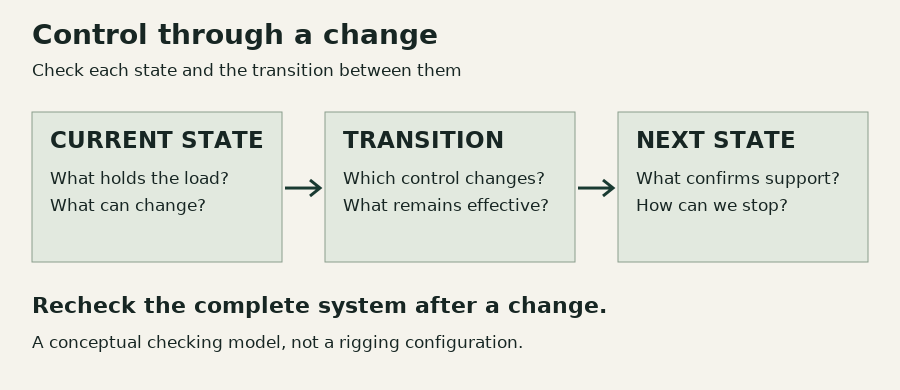
Knowing how a system was assembled can make an error harder to see: the builder tends to see the intended arrangement. A competent second person should follow the actual connections, rope route and device orientation. The check asks whether the assembled arrangement matches the approved method, whether components are compatible and whether the system can be operated and recovered.
A check is time-specific. Moving an anchor, changing a device mode, adding a load or altering the rope path can invalidate it. Say what changed and obtain the necessary recheck before movement resumes. Inspection is a practical skill with a defined scope; a second person who does not understand the system cannot provide a meaningful independent check.
A checked system is rearranged to make room, and the team assumes the earlier check still applies.
Treat a meaningful change as a new decision point. Identify the affected protection and recheck it.
On an unloaded trainer, the instructor changes one benign configuration detail. Learners explain which part of the earlier inspection is now stale. Do not insert hidden defects into a live safety system.
What would make you ask for a complete recheck rather than a local one?
A message succeeds when the intended person understands the intended action. Names, brief instructions and a confirmation reduce ambiguity, especially when people cannot see the same part of the incident. The team should agree who coordinates movement, how anybody can call a stop and what happens when a message is lost.
Repeating a message is useful only if the sender listens and corrects a misunderstanding. Silence, a nod from someone else or a remembered sequence is not confirmation. Before practical work, test the actual communication method from the positions people will occupy. Wind, water noise, cliff geometry and failed batteries can defeat a method that worked at the briefing.
One person hears lower while another hears hold.
Stop the affected movement and restore a shared understanding through the agreed fallback.
Use a tabletop load marker. A sender, operator and observer run a short movement sequence with one deliberately unclear message. The marker must stay still until the instruction is confirmed.
How will a new team member know which signal stops the exercise?
Many climbing problems begin as manageable interruptions: fear, fatigue, a missed stance or uncertainty about a command. A calm conversation and a verified ordinary lower may resolve the problem with fewer changes than a rescue system. Ask what the climber can do, check the route to the landing and keep the belayer in control while deciding.
Climbing equipment works in particular modes. A device that assists braking is not permission to abandon the required brake-hand position, and a method demonstrated with one model may not transfer to another. The instructor must identify the exact model, compatible rope and approved procedure. Learn the purpose of each action as well as its sequence.
A group starts an elaborate rescue when the climber is responsive and a normal safe lower may be possible.
First verify whether the familiar controlled method reaches a safe destination.
Discuss three route photographs with different landing and communication conditions. Explain when an ordinary lower is suitable and when it must wait.
Which uncertainty would make you stop a normal lower?
A tired second below a stance can create pressure to haul immediately. Compare a short assisted movement, a controlled lower to a verified position and a stable hold. The best option depends on the climber’s condition, rope route, device mode, usable rope and what protection exists at the destination.
A traverse changes the problem. Moving up or down can also move the climber sideways, and releasing one constraint may create a swing. Trace the likely path before changing the loaded system. Explain what the climber can contribute and how the plan changes if communication or their ability to assist deteriorates.
A second hangs below a traverse and the team assumes that any short raise will help.
Consider the movement path and protected arrival, not only the vertical distance.
Mark a climber and rope path on a board. Compare a vertical pitch with a traverse. Demonstrate the selected approved movement on an inert trainer before protected application.
What could change the direction of the load during your plan?
Freeing a belayer transfers a job as well as a load. Before the original arrangement is released, the receiving system must be correctly connected, suitable for the expected load and able to control the next movement. Describe what each part is doing rather than treating the exercise as a sequence of knots.
Check shared dependencies. A backup attached through the same vulnerable connection may not provide the protection you expect. Keep the original support until the prescribed verification confirms the receiving state. The ability to reverse or hold the process matters as much as reaching the final arrangement.
The new system looks complete, but no one has checked whether it can release or lower afterwards.
Verify support, control, backup and the next action before giving up the original control.
Use coloured labels for current support, receiving support and control on an inert training setup. Pause at each transfer and explain what remains effective.
Can you return to the previous safe state from this point?
Mechanical advantage exchanges pulling distance for force in an ideal model. Real systems lose efficiency through friction and rope bending, and may have limited travel before a reset. A large advertised ratio can still be awkward or ineffective in a small stance.
Unexpected effort is information. The casualty may be obstructed, the rope may rub, a device may be in the wrong operating state or the system may have reached its travel limit. Stop and investigate before adding people or changing the ratio. Increased input can raise forces without producing useful movement.
The haul stalls and the first response is to recruit another person to pull.
Check the load, route and system state before increasing force.
Compare two instructor-approved tabletop or low-load trainers. Observe effort and travel without assigning universal efficiency values. Introduce an obvious external obstruction without trapping or loading a person.
What evidence would distinguish friction from an obstructed load?
For a loaded transfer, draw three columns headed before, during and after. In each column record the active support, the movement control and the next check. This makes it easier to see a gap hidden inside a fluent demonstration. A method may finish correctly yet pass through an unsafe intermediate state.
Use the table to rehearse a changed circumstance. For example, the intended receiving position becomes unavailable before the original support has been released. The learner should be able to identify the current protected state and explain the approved hold or reversal. The table is an aid to understanding; it must describe the validated method, rather than invent a new one.
A learner remembers the final arrangement but cannot explain what holds the load halfway through.
Make the intermediate state explicit before progressing.
Complete the three-column table for the instructor’s approved inert demonstration. Point to the corresponding real components at each pause.
Is any critical function absent or dependent on an unchecked connection during the transfer?
A responsive second cannot climb a traverse. They can communicate. You can see part of the route, but lowering vertically would put them away from the stance you originally intended.
Decide where the climber should finish before deciding how to move them. A vertical lower, a short assistance move and a return along the route solve different problems.
Describe how the rope direction and protection affect the person’s possible path. Confirm the useful rope, the terrain below and the climber’s ability to help. Keep the existing protection while this is established.
If the selected option changes a loaded system, explain what supports the person before, during and after the change. Practise the relevant approved method separately before combining it with route decisions.
Treating “lower them” as a complete plan without identifying the landing or possible sideways movement.
The climber reports that one arm is becoming difficult to use. Reconsider the amount of help your plan assumes they can provide.
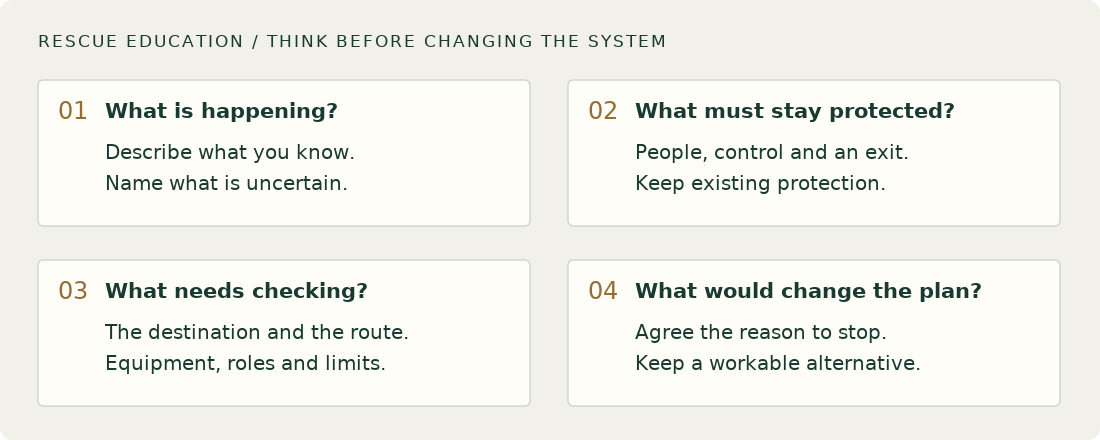
Answer in your own words before reading the explanations near the end of the handbook. These questions support revision; they do not replace practical assessment.
Explain your reasoning before checking the answer.
Explain your reasoning before checking the answer.
Explain your reasoning before checking the answer.
Controlled multipitch or stacked training stations with protected edges, instructor access and a tested intervention plan.
Use these outcome references with your instructor. Explain your decisions and demonstrate the task under the stated conditions. A safe stop can show judgement; any required physical skill still needs its own observed demonstration.
2A
Protect the party, trace the load path, identify a reachable refuge and compare movement with holding position.
Controlled multipitch or stacked training stations with protected edges, instructor access and a tested intervention plan.
Independent safe demonstration and an explanation of the decision.
2B
Identify the exact device and mode. Demonstrate controlled release and stopping on an approved inert trainer.
Controlled multipitch or stacked training stations with protected edges, instructor access and a tested intervention plan.
Independent safe demonstration and an explanation of the decision.
2C
Establish and verify the receiving system before releasing the original support. Explain each backup and shared failure point.
Controlled multipitch or stacked training stations with protected edges, instructor access and a tested intervention plan.
Independent safe demonstration and an explanation of the decision.
2D
Choose and demonstrate a controlled short lower and raise. Explain friction, progress capture and the consequences for the anchor.
Controlled multipitch or stacked training stations with protected edges, instructor access and a tested intervention plan.
Independent safe demonstration and an explanation of the decision.
2E
Plan and demonstrate a protected approach and secure contact. Account for edges, traverse geometry and a possible swing.
Controlled multipitch or stacked training stations with protected edges, instructor access and a tested intervention plan.
Independent safe demonstration and an explanation of the decision.
2F
Confirm rope reach, receiving protection and a secure arrival. Stop when the next station or line cannot be verified.
Controlled multipitch or stacked training stations with protected edges, instructor access and a tested intervention plan.
Independent safe demonstration and an explanation of the decision.
Start with the information in the problem. State your assumptions, choose a safe objective and explain what would make you change the plan. Apply technical skills only in the approved supervised exercise.
The top belay is loaded. The second is tired below a short steep section.
A convenient destination is not enough if the route or receiving protection is uncertain.
A traverse leaves the second out of reach.
Do not improvise an exposed reach or accept an uncontrolled pendulum.
A task competes with keeping the rope controlled.
Device assistance alone is not permission to abandon brake control.
Your team pulls harder, but the climber barely moves.
Stop before increasing forces on an unverified system. More pull can increase the problem.
You can see a ledge but cannot verify the anchor or reach.
Choose a stable hold when the next safe position cannot be confirmed.
The party is separated and the agreed signal is not confirmed.
A time delay or assumed sequence does not replace confirmation.
The assessor records your individual decisions and practical performance. The ratings are I for independent and safe, C for coached or incomplete, N for not observed and S for a safety intervention. A missing or unsafe outcome cannot be balanced by a strong performance elsewhere.
If evidence is incomplete, you receive the observed gaps and a targeted practice plan. Reassessment checks the affected skills and their interaction in a scenario. Use the private support route for an appeal or a correction to your record.
After a recorded pass, submit the short course evaluation. Critical feedback and positive feedback have exactly the same effect on eligibility. Your certificate includes the assessment date, instructor, programme edition and a verification code. An award image alone is not a verifiable credential.
Keep a short record for each practice session. Do not enter unnecessary medical details or another person’s private information. A practice log supports learning; the course record and award remain in the portal.
Date and location
Skill or outcome reference
Conditions and equipment or method reference
What I did and why
Feedback and any intervention
What I will practise next and with whom
It may move the person across an edge, into an obstruction or away from a useful destination. Judge the person’s path as well as the rope path.
Not necessarily. First find the cause: obstruction, geometry, friction, a device state or the casualty’s position may be responsible. Increasing force can make an unresolved problem worse.
The receiving arrangement has been checked and is controlling the intended load as required by the approved method. The original support is not removed merely because a new connection has been clipped.
Load transfer — A controlled change in which arrangement supports a person or load.
Receiving system — The arrangement intended to take control during a transfer.
Directional — A point that changes the rope’s path and therefore the forces in the system.
Fallback — A prepared response if the intended movement cannot continue.
Use the current instructions for the exact model of equipment on your course. Check its intended use, compatible components, inspection points and operating limits. A similar-looking device may behave differently.
Ask your instructor to show how the approved method sheet and equipment instructions fit together. Report anything that is unclear before practical use. The references below are selected primary sources; they do not certify this course.
Petzl Rope too short warning danger Current public technical tip checked 6 November 2026; page gives no edition date
CR1 prevention lesson only; publisher examples beyond our scope are not adopted.
Petzl Professional Catalogue Technical Rescue 2026
Corroborates that a labelled ratio is not measured system performance; no product configurations or capacities adopted.