
1. What does a minimum distance reading establish?
Explain your reasoning before checking the answer.
AVR / LEARNER HANDBOOK / EDITION 0.2
Organise and carry out a small-party response to a simulated avalanche burial, from scene safety and search through excavation, basic care and emergency handover. Suitable as first rescue training or a practical refresher.
Draft handbook for review. This course is not yet open.
Our aim is to make high-quality rescue education more accessible. This handbook helps you understand the decisions behind the skills, prepare for your course and revise afterwards.
Read the explanations, try the worked case and answer the questions before checking the reasoning. Bring uncertainties to your instructor. Practical learning uses the approved methods and the actual equipment supplied for your course.
Technical review edition 0.2. The course is not yet open. Practical method sheets, equipment configurations and assessment stations still require technical approval and pilot testing.
Organise and carry out a small-party response to a simulated avalanche burial, from scene safety and search through excavation, basic care and emergency handover. Suitable as first rescue training or a practical refresher.
Adults aged 18 or over, with basic avalanche-awareness preparation and suitable winter movement skills for the venue. AV1 is not mandatory. Current first aid/CPR is required before certification; prior learning can be verified without repeating a course.
Read the learner handbook and complete the forecast/terrain introduction.
Bring serviceable equipment or arrange loan equipment; disclose access needs privately with the provider.
Practise basic winter movement appropriate to the course; technical travel instruction can be arranged separately.
Expect repeated practice and individual demonstration rather than a fixed completion time.
Identify local emergency contact arrangements and bring current first-aid details where required.
Practise the complete companion rescue response, with each person able to perform the required search and recovery skills.
Before the course, read the explanations and note the terms you do not know. During the course, connect each explanation to the supervised demonstration. Afterwards, use the questions and your practice record to identify what needs refreshing.
An avalanche incident can overwhelm a small party. A brief, clear response helps people act with purpose. Assess continuing danger, gather the last-seen and missing-person information, identify who can search and who can call for help, and make sure the group understands the immediate plan. Keep reviewing the scene as information changes.
Calling for professional assistance and starting a safe companion response are complementary tasks. The best arrangement depends on people, communications and hazards. Your course scenarios will vary those conditions so you can explain your choices rather than rely on a memorised command list.
Everyone follows the first visible clue and nobody keeps the overall picture. Assign coordination and repeat the missing-person count.
Give a short response briefing for three people facing one missing companion, then repeat with one person unable to help physically.
A transceiver gives information that changes as the search progresses. Early searching aims to acquire a useful signal while also noticing clues. Closer to the target, controlled movement and careful interpretation become more important. Rushing the change between phases can create repeated overshoots and wasted movement.
Use the exact search process taught for the approved equipment and method annex. Explain what information you are following and what would make you reassess. When a result seems implausible, maintain the overall search plan while checking the likely cause. A screen is an aid to judgement, not a substitute for systematic coverage.
Making large hurried movements close to the target. Practise controlled transitions before adding realistic pressure.
Narrate a low-pressure search, then repeat independently without prompts and compare the actions, not just elapsed time.
The transceiver search narrows the area; a confirmed probe strike gives a physical location for excavation. Probing therefore has a different job from searching with the receiver. Learn the approved pinpoint pattern and how to recognise and manage an uncertain strike. Preserve the confirmed reference so the digging team can work toward it.
Excavation requires space, coordination and effort. A deep narrow hole may make progress harder and leave little room to reach or care for the person. Follow the validated digging method for the slope, depth and number of rescuers. Rotate tasks before fatigue undermines safe tool use and effective work.
Treating a hard layer as a definite target or losing the location while digging. Communicate uncertainty and preserve the reference.
Locate and excavate a nonhuman target while changing team size. Explain how the work arrangement changes and why.
Multiple missing people introduce more tasks than a small party may be able to do at once. Keep the missing-person count explicit and separate a found signal from a located person and a person reached. Use device functions only when you understand what they do and what information they might hide from view.
A coordinated team can search, excavate, call for help and prepare care in parallel when enough people are available. When resources are limited, use the approved rescue and medical priorities taught by your instructor. Reassess as a casualty is reached or a rescuer becomes exhausted. Accurate communication matters as much as speed.
Announcing “found” when only a transmitter signal has been acquired. Say exactly what stage has been completed.
Run a two-target station with role changes. At pauses, each participant states who remains missing and which tasks are active.
Unfamiliar controls, wrong modes, poor battery preparation and interference can all disrupt a rescue. The best first defence is practice with the equipment actually carried. Check current instructions and joint interference guidance before the season, including the way electronics and magnetic items sit against your clothing.
If a problem arises during a search, use the approved corrective actions while keeping the search coordinated. Avoid adding unnecessary steps that delay rescue. Do not assume that every missing person is transmitting: maintain clue awareness and be ready to move to the approved non-transceiver response while requesting professional help.
Interpreting a confusing display as proof the target must be elsewhere. Check technique and relevant interference before abandoning the search logic.
The instructor introduces a harmless simulated equipment problem and observes how you identify it, communicate and recover.
Reaching the target is a transition, not the end of the response. The casualty may need immediate care, protection from cold and a carefully organised evacuation. Work within current first-aid training and the approved local clinical annex, with emergency-service guidance where available. Use manikins for care practice.
Record what you know: when the incident was seen, when the person was reached, what you observed and what you did. Separate known times from estimates. Give arriving rescuers a concise account of hazards, missing people and patient condition. After the exercise, review the whole response and agree the next practice priorities.
A successful search is celebrated while basic care and communication are forgotten. Include those tasks in every complete scenario.
Deliver a handover from a station record containing both known facts and uncertainties; the receiver should be able to repeat the essentials.
In a controlled exercise, a searcher detects the buried training transceiver. Everyone gathers around them. No one has prepared a probe or shovel, and the group has lost track of which area was searched.
Keep clear roles and communicate progress. Finding a signal narrows the task; it does not locate the person exactly or prepare their recovery.
The searcher continues through the appropriate search phases while available teammates prepare the next tasks without interfering. Record the location and status clearly enough that another person can understand them.
Debrief the full exercise, including scene priorities, location, excavation, care and help activation. A fast signal search can hide avoidable delays elsewhere.
Measuring only the time to the first signal and missing the rest of the rescue.
The instructor adds credible information that another person is missing. Explain how to preserve the known location while revising the search plan.
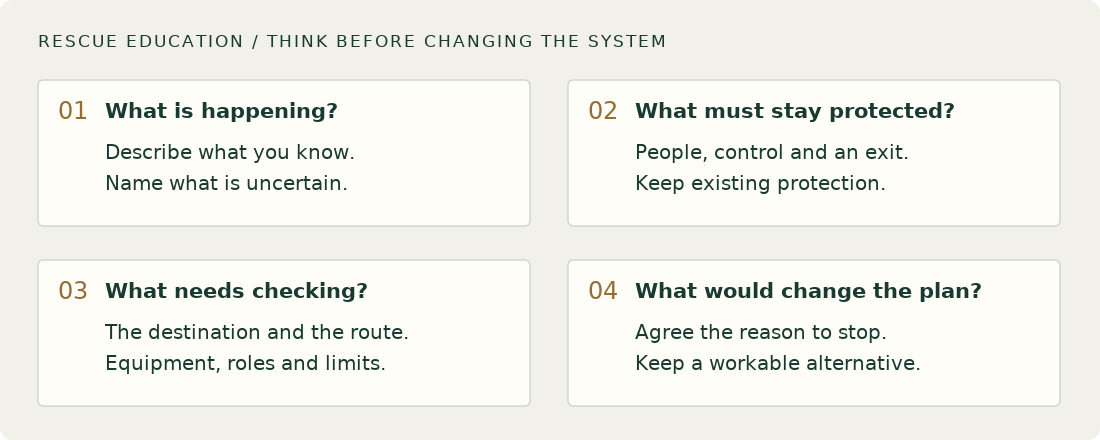
Answer in your own words before reading the explanations near the end of the handbook. These questions support revision; they do not replace practical assessment.
Explain your reasoning before checking the answer.
Explain your reasoning before checking the answer.
Explain your reasoning before checking the answer.
Checked winter training ground and journeys matched to the instructor’s approved travel mode and terrain, with escape options and verified emergency arrangements. Search/digging stations are outside avalanche exposure; assessment never requires hazardous slope entry.
Current serviceable multi-antenna avalanche transceiver for every participant, with manufacturer-approved batteries and carriage
Individual avalanche probe and purpose-designed metal rescue shovel; equipment traceable to instructions and inspection
Suitable winter clothing, spare gloves, eye protection, footwear and equipment for the recorded travel mode
Map/navigation tools, forecast access and offline alternatives; instructor slope-measurement and observation equipment
Emergency communications with backup, group shelter, first-aid kit and feasible evacuation resources
Training transmitters, nonhuman burial targets and care manikins; station boundary markers
Use a named instructor with verified avalanche and winter travel competence in the recorded environment, activity and snow climate; all participants can stop the exercise.
Practise search and digging only in a checked location outside avalanche exposure, including overhead paths and runout, cornices, tree wells, crevasses, traffic and other local hazards. Instructor reassesses after change.
Never bury a living person, even shallowly. Use instrumented bags or manikins. Keep shovel/probe practice away from people and manage cold, fatigue and hand injuries.
No deliberate avalanche triggering or exposure is required to teach or assess these awards. Relocate, postpone or simulate the decision when conditions exceed the approved envelope.
Check every transceiver according to its current manufacturer instructions, battery/service/recall status and the approved interference guidance. Verify final transmit mode and secure carriage before travel.
Pre-brief communication, shelter, emergency contact, evacuation, weather limits and lost-person actions; verify that rescue cover is realistic before leaving the safe area.
A timed exercise never rewards bypassing scene safety, missing-person accounting or casualty care. A safety intervention stops the attempt; record learning and a new independent reassessment.
Assessment records each learner’s observable actions and reasoning. Team success and attendance alone cannot satisfy another person’s outcomes.
Use the approved local clinical annex and training manikins for care demonstrations; activate professional assistance and act within current first-aid training.
Keep individual teaching, practice and assessment evidence; content version, method annex, venue and travel-mode scope accompany the award record.
Use these outcome references with your instructor. Explain your decisions and demonstrate the task under the stated conditions. A safe stop can show judgement; any required physical skill still needs its own observed demonstration.
AVR-A
Prepare and check the rescue equipment, communication and group plan using current instructions. Demonstrate independently after practice; explain the reason for action and when to stop. Safety-critical failures cannot be offset by strengths elsewhere.
A loan transceiver has unfamiliar controls.
Use the signed venue and method annex, appropriate current equipment instructions, realistic snow and dedicated safety coverage. Assess independently after coached practice. Knowledge or simulation can support understanding but cannot replace the practical evidence specified. Record travel mode, snow climate and conditions.
Demonstrate the required functions and readiness; replace unsuitable equipment before starting. Record individual actions, conditions, dates, method version and assessor judgement. Practical observations are mandatory where named.
AVR-B
Recognise residual hazards, establish last-seen information and number missing, assign tasks and organise help. Demonstrate independently after practice; explain the reason for action and when to stop. Safety-critical failures cannot be offset by strengths elsewhere.
A visible clue tempts the whole group into the same hazardous area.
Use the signed venue and method annex, appropriate current equipment instructions, realistic snow and dedicated safety coverage. Assess independently after coached practice. Knowledge or simulation can support understanding but cannot replace the practical evidence specified. Record travel mode, snow climate and conditions.
Brief a coordinated response and make a justified go/modify/stop decision. Record individual actions, conditions, dates, method version and assessor judgement. Practical observations are mandatory where named.
AVR-C
Maintain visual/auditory clue awareness and systematic coverage when a transmitter signal is absent; request organized rescue. Demonstrate independently after practice; explain the reason for action and when to stop. Safety-critical failures cannot be offset by strengths elsewhere.
The missing person may not have a working transmitter.
Use the signed venue and method annex, appropriate current equipment instructions, realistic snow and dedicated safety coverage. Assess independently after coached practice. Knowledge or simulation can support understanding but cannot replace the practical evidence specified. Record travel mode, snow climate and conditions.
Explain and demonstrate the approved companion search plan without assuming a transceiver will find everyone. Record individual actions, conditions, dates, method version and assessor judgement. Practical observations are mandatory where named.
AVR-D
Demonstrate the approved signal, coarse and fine-search sequence using actual equipment. Demonstrate independently after practice; explain the reason for action and when to stop. Safety-critical failures cannot be offset by strengths elsewhere.
Search direction reverses after a rushed approach.
Use the signed venue and method annex, appropriate current equipment instructions, realistic snow and dedicated safety coverage. Assess independently after coached practice. Knowledge or simulation can support understanding but cannot replace the practical evidence specified. Record travel mode, snow climate and conditions.
Recover methodically, locate the target area and explain why each search phase changes. Record individual actions, conditions, dates, method version and assessor judgement. Practical observations are mandatory where named.
AVR-E
Deploy and use the probe with the approved companion pinpoint method, confirm a strike and preserve the location for digging. Demonstrate independently after practice; explain the reason for action and when to stop. Safety-critical failures cannot be offset by strengths elsewhere.
A hard layer produces an uncertain strike.
Use the signed venue and method annex, appropriate current equipment instructions, realistic snow and dedicated safety coverage. Assess independently after coached practice. Knowledge or simulation can support understanding but cannot replace the practical evidence specified. Record travel mode, snow climate and conditions.
Distinguish uncertainty, continue systematically and maintain the confirmed reference. Record individual actions, conditions, dates, method version and assessor judgement. Practical observations are mandatory where named.
AVR-F
Organise excavation and rotations for available people and snow without injuring rescuers or the target. Demonstrate independently after practice; explain the reason for action and when to stop. Safety-critical failures cannot be offset by strengths elsewhere.
Several rescuers dig narrow holes directly above the target.
Use the signed venue and method annex, appropriate current equipment instructions, realistic snow and dedicated safety coverage. Assess independently after coached practice. Knowledge or simulation can support understanding but cannot replace the practical evidence specified. Record travel mode, snow climate and conditions.
Create working space and an effective approach according to the validated digging method. Record individual actions, conditions, dates, method version and assessor judgement. Practical observations are mandatory where named.
AVR-G
Maintain a missing-person tally and coordinate searching and digging; use device functions without losing situational awareness. Demonstrate independently after practice; explain the reason for action and when to stop. Safety-critical failures cannot be offset by strengths elsewhere.
A found target distracts the team from another missing person.
Use the signed venue and method annex, appropriate current equipment instructions, realistic snow and dedicated safety coverage. Assess independently after coached practice. Knowledge or simulation can support understanding but cannot replace the practical evidence specified. Record travel mode, snow climate and conditions.
Respond to two nonhuman targets; record each role and unresolved uncertainty. Record individual actions, conditions, dates, method version and assessor judgement. Practical observations are mandatory where named.
AVR-H
Identify likely interference, mode errors and unfamiliar functions; apply the current guidance without unnecessary delay. Demonstrate independently after practice; explain the reason for action and when to stop. Safety-critical failures cannot be offset by strengths elsewhere.
A magnetic closure or active electronic device is close to the transceiver.
Use the signed venue and method annex, appropriate current equipment instructions, realistic snow and dedicated safety coverage. Assess independently after coached practice. Knowledge or simulation can support understanding but cannot replace the practical evidence specified. Record travel mode, snow climate and conditions.
Correct the relevant issue using model-specific instructions and approved guidance. Record individual actions, conditions, dates, method version and assessor judgement. Practical observations are mandatory where named.
AVR-I
Provide the locally approved response within first-aid competence, protect from further cold exposure and report essential burial/rescue details. Demonstrate independently after practice; explain the reason for action and when to stop. Safety-critical failures cannot be offset by strengths elsewhere.
The excavated manikin requires immediate care while one person is still missing.
Use the signed venue and method annex, appropriate current equipment instructions, realistic snow and dedicated safety coverage. Assess independently after coached practice. Knowledge or simulation can support understanding but cannot replace the practical evidence specified. Record travel mode, snow climate and conditions.
Use assigned roles, call for help, demonstrate care and relay accurate times and observations. Record individual actions, conditions, dates, method version and assessor judgement. Practical observations are mandatory where named.
AVR-J
Set up a safe practice station and use a record of actions and delays to guide improvement. Demonstrate independently after practice; explain the reason for action and when to stop. Safety-critical failures cannot be offset by strengths elsewhere.
The fastest practice run omitted a safety check.
Use the signed venue and method annex, appropriate current equipment instructions, realistic snow and dedicated safety coverage. Assess independently after coached practice. Knowledge or simulation can support understanding but cannot replace the practical evidence specified. Record travel mode, snow climate and conditions.
Identify unsafe shortcuts in a sample practice run; plan a new safe attempt with measurable improvement. Record individual actions, conditions, dates, method version and assessor judgement.
Start with the information in the problem. State your assumptions, choose a safe objective and explain what would make you change the plan. Apply technical skills only in the approved supervised exercise.
A small party must find and excavate one training target using serviceable but unfamiliar equipment.
Readiness, scene management and each search/dig/care stage.
Use checked terrain and nonhuman targets outside avalanche exposure. Separate learning from final assessment. Approved station annex fixes area, target geometry, snow conditions, realistic time expectations and safety cover before pilot; no arbitrary universal pass time.
Two nonhuman targets and a tired helper require task allocation.
Accounting, prioritisation under the approved protocol, individual search skills and a coordinated handover.
Use checked terrain and nonhuman targets outside avalanche exposure. Separate learning from final assessment. Approved station annex fixes area, target geometry, snow conditions, realistic time expectations and safety cover before pilot; no arbitrary universal pass time.
A clue is visible but a simulated missing person has no working transmitter.
Residual hazard review, appropriate clue-led search, escalation and accurate uncertainty.
Use checked terrain and nonhuman targets outside avalanche exposure. Separate learning from final assessment. Approved station annex fixes area, target geometry, snow conditions, realistic time expectations and safety cover before pilot; no arbitrary universal pass time.
The assessor records your individual decisions and practical performance. The ratings are I for independent and safe, C for coached or incomplete, N for not observed and S for a safety intervention. A missing or unsafe outcome cannot be balanced by a strong performance elsewhere.
Your approved course instructor may also assess this recreational award. Teaching and coached practice are separated from the final independent demonstration. You can ask for the reasons for a result and use the independent appeal route if you disagree.
If evidence is incomplete, you receive the observed gaps and a targeted practice plan. Reassessment checks the affected skills and their interaction in a scenario. Use the private support route for an appeal or a correction to your record.
After a recorded pass, submit the short course evaluation. Critical feedback and positive feedback have exactly the same effect on eligibility. Your certificate includes the assessment date, instructor, programme edition and a verification code. An award image alone is not a verifiable credential.
Keep a short record for each practice session. Do not enter unnecessary medical details or another person’s private information. A practice log supports learning; the course record and award remain in the portal.
Date and location
Skill or outcome reference
Conditions and equipment or method reference
What I did and why
Feedback and any intervention
What I will practise next and with whom
An approximate location requiring the prescribed fine search and pinpoint probing. It is not confirmation that the casualty has been physically located.
Controls, display behaviour and interference precautions vary. Familiarity with one device does not establish competence with another.
No. It is a device function used within a search strategy. Maintain an explicit missing-person count and confirm what has actually been found.
Signal and clue search — Looking systematically for initial signals and evidence of a missing person.
Coarse search — Following a detected signal towards an approximate location.
Fine search — A precise, systematic search to refine that location.
Pinpoint probing — Using a probe to confirm the buried person’s location.
Use the current instructions for the exact model of equipment on your course. Check its intended use, compatible components, inspection points and operating limits. A similar-looking device may behave differently.
Ask your instructor to show how the approved method sheet and equipment instructions fit together. Report anything that is unclear before practical use. The references below are selected primary sources; they do not certify this course.
ICAR search phases Recommendation 009, updated 2025 Reviewed November 2026
Rescue commission recommendation.
Joint recreational transceiver interference guidance, hosted CAIC Reviewed November 2026
Manufacturer/forecast-centre collaborative technical guidance.
ERC 2025 Special Circumstances final guideline Reviewed November 2026
Clinical guideline, not instructor/award standard.
WMS 2024 avalanche guidance summary Reviewed November 2026
Clinical practice guidance.
UIAA equipment standards Reviewed November 2026
Equipment performance standards, not award syllabus.