
1. Why define the question before choosing a snow observation?
Explain your reasoning before checking the answer.
AV2 / LEARNER HANDBOOK / EDITION 0.2
Plan, lead and review recreational winter journeys using multiple information sources, deliberate terrain choices and clear group decisions, while managing uncertainty and maintaining companion-rescue readiness.
Draft handbook for review. This course is not yet open.
Our aim is to make high-quality rescue education more accessible. This handbook helps you understand the decisions behind the skills, prepare for your course and revise afterwards.
Read the explanations, try the worked case and answer the questions before checking the reasoning. Bring uncertainties to your instructor. Practical learning uses the approved methods and the actual equipment supplied for your course.
Technical review edition 0.2. The course is not yet open. Practical method sheets, equipment configurations and assessment stations still require technical approval and pilot testing.
Plan, lead and review recreational winter journeys using multiple information sources, deliberate terrain choices and clear group decisions, while managing uncertainty and maintaining companion-rescue readiness.
AV1 or verified equivalent learning, plus AVR or verified equivalent rescue competence. Document at least one winter season of relevant experience after foundation learning, including varied trips and reflection. Instructor verifies practical winter travel readiness and current rescue/first-aid competence; gaps receive targeted development.
Read the learner handbook and complete the forecast/terrain introduction.
Bring serviceable equipment or arrange loan equipment; disclose access needs privately with the provider.
Practise basic winter movement appropriate to the course; technical travel instruction can be arranged separately.
Expect repeated practice and individual demonstration rather than a fixed completion time.
Identify local emergency contact arrangements and bring current first-aid details where required.
Build and challenge a hazard picture without allowing one observation to outweigh its actual value.
Before the course, read the explanations and note the terms you do not know. During the course, connect each explanation to the supervised demonstration. Afterwards, use the questions and your practice record to identify what needs refreshing.
Advanced recreational decisions depend on combining information without pretending it is complete. Start with current forecasts and weather history, then add observations from the intended area. Ask how reliable each item is, what place and time it describes and whether it supports or conflicts with the others. Keep uncertainty visible in the plan.
A neighbouring forecast or a single report may be useful, but transfer is an inference. Different elevation, wind exposure or snow history may change the problem. When information is thin, choose terrain and objectives that tolerate uncertainty. More complicated analysis does not justify a smaller safety margin.
Filling a forecast gap with confidence. State what is unknown and show how the plan changes because of it.
Build two route options from incomplete information and explain the additional evidence that would be needed before considering a more exposed option.
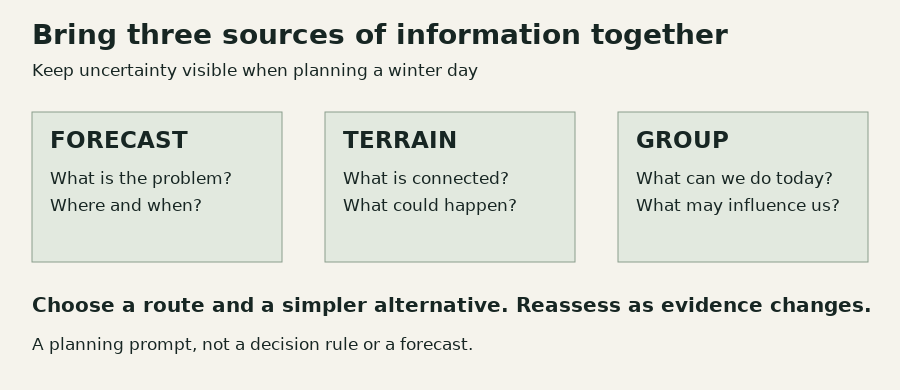
Observation is useful when it addresses a relevant uncertainty. Before selecting a test or digging a profile, say what you are trying to learn and whether the location can be reached safely. Follow the agreed observation method so another person can understand what was done. Record the location and conditions as well as the result.
Snow varies across the landscape. One reassuring result cannot clear a whole slope or cancel a regional warning. A test may reveal a problem while failing to show its full extent. Integrate the result with terrain, weather history and other observations, and explain the confidence you place in it.
Searching for a favourable result after deciding to ski a slope. Decide in advance how different results would affect the plan.
Compare two observation records from different aspects. Identify what each can support and which conclusions would overreach the evidence.
A route has more than a destination. It has commitment points, places to regroup, possible exits and sections where observation or communication becomes difficult. Identify these before departure and revisit them as the day develops. A useful alternative is one the group can actually reach with its remaining time and energy.
Plan for the least robust part of the group, including fatigue, equipment problems and unfamiliar movement skills. When a decision would remove a safe exit, make that tradeoff explicit. Good leadership can mean keeping the day simpler so the team retains options as conditions change.
Naming an alternative that cannot be reached without crossing the same hazard. Check its complete approach and exit.
Mark the last practical retreat point on a proposed journey and brief the conditions that would make the group stop there.
Recreational leadership is a process of helping a group make a clear, informed choice. Ask for observations and concerns before arguing for an objective. Separate evidence from preference, identify disagreements and agree what happens next. A leader should make it easier for someone to stop the group when something does not fit.
Experience can create its own pressure. People may defer to a familiar leader or confuse fluent technical language with good judgement. Check that each member understands the plan and its stopping conditions. A challenge to the plan is information to examine, not a test of loyalty.
Asking for opinions only after announcing a strong preference. Gather independent observations first.
Facilitate a decision involving mixed experience, a time commitment and conflicting observations. End with an explicit decision and a shared reason.
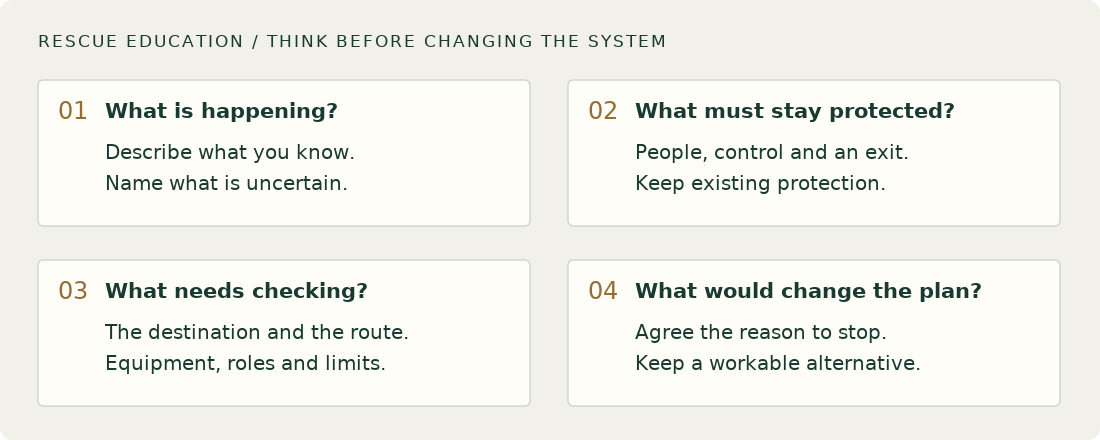
A plan is a set of expectations about conditions, terrain and the party. During travel, compare those expectations with what is happening. A change in wind loading, visibility, temperature or group performance may matter before it becomes dramatic. Use preselected decision places to review the picture without waiting for a crisis.
When the picture changes, slow the decision down while keeping the group in a suitable place. Name the mismatch, identify what is now uncertain and choose a conservative action. Do not allow the effort already invested in the day to become evidence for continuing.
Explaining away each small warning separately until the group is committed. Review the combined pattern.
Respond to a sequence of instructor information cards during a safe journey. Record the point at which your original plan changes and why.
Better planning and rescue readiness support each other. Rescue equipment cannot make an unsuitable terrain choice acceptable, and careful planning cannot guarantee that rescue skills will never be needed. Maintain individual companion-rescue competence while practising how a group coordinates tasks under pressure.
After a journey or rescue exercise, review decision quality as well as task performance. Ask what the team noticed early, where communication failed and which preparation made a useful difference. Keep a practice plan specific enough to act on, including unfamiliar equipment, less-used roles and changes in travel context.
Assuming the group leader will perform every technical task in an incident. Everyone needs practised responsibilities.
Rotate coordination and practical roles in a controlled rescue exercise, then write a short review linking preparation, decisions and observable results.
Your group has a plan based on a forecast problem affecting the intended terrain. A snow observation at a convenient sheltered location appears reassuring. The next part of the route has a different exposure to wind.
State which question the observation can answer and which terrain it represents. A result from one place does not automatically describe the next slope.
Compare it with the wider information: recent weather, forecast distribution, terrain and observations made during travel. Look for an explanation of disagreement instead of discarding the inconvenient evidence.
Keep the alternative route available. If important uncertainty cannot be resolved from an appropriately safe position, reduce exposure rather than collecting more data from the threatened terrain.
Using a reassuring result as permission for a decision already made.
Another group reports a concerning observation nearby, but its time and location are unclear. Explain how you would use that information without inventing precision.
Answer in your own words before reading the explanations near the end of the handbook. These questions support revision; they do not replace practical assessment.
Explain your reasoning before checking the answer.
Explain your reasoning before checking the answer.
Explain your reasoning before checking the answer.
Checked winter training ground and journeys matched to the instructor’s approved travel mode and terrain, with escape options and verified emergency arrangements. Search/digging stations are outside avalanche exposure; assessment never requires hazardous slope entry.
Current serviceable multi-antenna avalanche transceiver for every participant, with manufacturer-approved batteries and carriage
Individual avalanche probe and purpose-designed metal rescue shovel; equipment traceable to instructions and inspection
Suitable winter clothing, spare gloves, eye protection, footwear and equipment for the recorded travel mode
Map/navigation tools, forecast access and offline alternatives; instructor slope-measurement and observation equipment
Emergency communications with backup, group shelter, first-aid kit and feasible evacuation resources
Training transmitters, nonhuman burial targets and care manikins; station boundary markers
Use a named instructor with verified avalanche and winter travel competence in the recorded environment, activity and snow climate; all participants can stop the exercise.
Practise search and digging only in a checked location outside avalanche exposure, including overhead paths and runout, cornices, tree wells, crevasses, traffic and other local hazards. Instructor reassesses after change.
Never bury a living person, even shallowly. Use instrumented bags or manikins. Keep shovel/probe practice away from people and manage cold, fatigue and hand injuries.
No deliberate avalanche triggering or exposure is required to teach or assess these awards. Relocate, postpone or simulate the decision when conditions exceed the approved envelope.
Check every transceiver according to its current manufacturer instructions, battery/service/recall status and the approved interference guidance. Verify final transmit mode and secure carriage before travel.
Pre-brief communication, shelter, emergency contact, evacuation, weather limits and lost-person actions; verify that rescue cover is realistic before leaving the safe area.
A timed exercise never rewards bypassing scene safety, missing-person accounting or casualty care. A safety intervention stops the attempt; record learning and a new independent reassessment.
Assessment records each learner’s observable actions and reasoning. Team success and attendance alone cannot satisfy another person’s outcomes.
Use the approved local clinical annex and training manikins for care demonstrations; activate professional assistance and act within current first-aid training.
Keep individual teaching, practice and assessment evidence; content version, method annex, venue and travel-mode scope accompany the award record.
Use these outcome references with your instructor. Explain your decisions and demonstrate the task under the stated conditions. A safe stop can show judgement; any required physical skill still needs its own observed demonstration.
AV2-A
Review personal trip decisions, current rescue skills and unfamiliar environments before planning. Demonstrate independently after practice; explain the reason for action and when to stop. Safety-critical failures cannot be offset by strengths elsewhere.
A strong skier has little experience in this snow climate.
Use the signed venue and method annex, appropriate current equipment instructions, realistic snow and dedicated safety coverage. Assess independently after coached practice. Knowledge or simulation can support understanding but cannot replace the practical evidence specified. Record travel mode, snow climate and conditions.
Identify transfer gaps and adjust the team plan rather than assuming competence transfers automatically. Record individual actions, conditions, dates, method version and assessor judgement. Practical observations are mandatory where named.
AV2-B
Integrate forecast, weather history, local observations and uncertainty; distinguish evidence from assumptions. Demonstrate independently after practice; explain the reason for action and when to stop. Safety-critical failures cannot be offset by strengths elsewhere.
The bulletin covers a neighbouring range but not the intended valley.
Use the signed venue and method annex, appropriate current equipment instructions, realistic snow and dedicated safety coverage. Assess independently after coached practice. Knowledge or simulation can support understanding but cannot replace the practical evidence specified. Record travel mode, snow climate and conditions.
State what transfers, what does not and how uncertainty changes the terrain choice. Record individual actions, conditions, dates, method version and assessor judgement. Practical observations are mandatory where named.
AV2-C
Relate loading, temperature, wind and layer evolution to the relevant avalanche problems without pretending a sample represents a whole slope. Demonstrate independently after practice; explain the reason for action and when to stop. Safety-critical failures cannot be offset by strengths elsewhere.
One reassuring pit contradicts a persistent-weak-layer forecast.
Use the signed venue and method annex, appropriate current equipment instructions, realistic snow and dedicated safety coverage. Assess independently after coached practice. Knowledge or simulation can support understanding but cannot replace the practical evidence specified. Record travel mode, snow climate and conditions.
Explain spatial variability and maintain a defensible conservative decision. Record individual actions, conditions, dates, method version and assessor judgement. Practical observations are mandatory where named.
AV2-D
Select safe, relevant observations/tests; collect consistently and explain their limitations. Demonstrate independently after practice; explain the reason for action and when to stop. Safety-critical failures cannot be offset by strengths elsewhere.
The only appealing test location is exposed to the problem being investigated.
Use the signed venue and method annex, appropriate current equipment instructions, realistic snow and dedicated safety coverage. Assess independently after coached practice. Knowledge or simulation can support understanding but cannot replace the practical evidence specified. Record travel mode, snow climate and conditions.
Reject unsafe sampling and use alternative information; describe confidence accurately. Record individual actions, conditions, dates, method version and assessor judgement. Practical observations are mandatory where named.
AV2-E
Develop realistic terrain options, decision points and exit routes for different conditions and group performance. Demonstrate independently after practice; explain the reason for action and when to stop. Safety-critical failures cannot be offset by strengths elsewhere.
The descent cannot be inspected and retreat becomes harder beyond a col.
Use the signed venue and method annex, appropriate current equipment instructions, realistic snow and dedicated safety coverage. Assess independently after coached practice. Knowledge or simulation can support understanding but cannot replace the practical evidence specified. Record travel mode, snow climate and conditions.
Identify the commitment point and choose a plan retaining an acceptable exit. Record individual actions, conditions, dates, method version and assessor judgement. Practical observations are mandatory where named.
AV2-F
Facilitate equal participation, explicit uncertainty and agreed decision criteria; manage pressure and fatigue. Demonstrate independently after practice; explain the reason for action and when to stop. Safety-critical failures cannot be offset by strengths elsewhere.
A booked hut and limited holiday time create pressure to continue.
Use the signed venue and method annex, appropriate current equipment instructions, realistic snow and dedicated safety coverage. Assess independently after coached practice. Knowledge or simulation can support understanding but cannot replace the practical evidence specified. Record travel mode, snow climate and conditions.
Lead a discussion that can genuinely result in changing or abandoning the objective. Record individual actions, conditions, dates, method version and assessor judgement. Practical observations are mandatory where named.
AV2-G
Match observations to expectations; revise route, spacing, regrouping and timing within the approved terrain envelope. Demonstrate independently after practice; explain the reason for action and when to stop. Safety-critical failures cannot be offset by strengths elsewhere.
Wind loading develops sooner than forecast.
Use the signed venue and method annex, appropriate current equipment instructions, realistic snow and dedicated safety coverage. Assess independently after coached practice. Knowledge or simulation can support understanding but cannot replace the practical evidence specified. Record travel mode, snow climate and conditions.
Recognise the mismatch, communicate it and implement a documented conservative change. Record individual actions, conditions, dates, method version and assessor judgement. Practical observations are mandatory where named.
AV2-H
Make a defensible limited plan when forecast, visibility or communications are incomplete. Demonstrate independently after practice; explain the reason for action and when to stop. Safety-critical failures cannot be offset by strengths elsewhere.
The phone has no coverage and downloaded maps lack the latest bulletin.
Use the signed venue and method annex, appropriate current equipment instructions, realistic snow and dedicated safety coverage. Assess independently after coached practice. Knowledge or simulation can support understanding but cannot replace the practical evidence specified. Record travel mode, snow climate and conditions.
Use prepared alternatives and explicit stopping limits; do not manufacture a precise forecast. Record individual actions, conditions, dates, method version and assessor judgement. Practical observations are mandatory where named.
AV2-I
Maintain current AVR-level practical performance while managing a small party and conflicting tasks. Demonstrate independently after practice; explain the reason for action and when to stop. Safety-critical failures cannot be offset by strengths elsewhere.
One rescuer is exhausted during a two-target exercise.
Use the signed venue and method annex, appropriate current equipment instructions, realistic snow and dedicated safety coverage. Assess independently after coached practice. Knowledge or simulation can support understanding but cannot replace the practical evidence specified. Record travel mode, snow climate and conditions.
Reassign tasks and complete the safe response; every learner demonstrates an assessed individual role and practical rescue skills. Record individual actions, conditions, dates, method version and assessor judgement. Practical observations are mandatory where named.
AV2-J
Compare expectations with actual observations, preserve uncertainty and create a specific action plan. Demonstrate independently after practice; explain the reason for action and when to stop. Safety-critical failures cannot be offset by strengths elsewhere.
Nothing happened despite several ignored warning signs.
Use the signed venue and method annex, appropriate current equipment instructions, realistic snow and dedicated safety coverage. Assess independently after coached practice. Knowledge or simulation can support understanding but cannot replace the practical evidence specified. Record travel mode, snow climate and conditions.
Identify process weaknesses independently of the outcome; produce a useful trip reflection. Record individual actions, conditions, dates, method version and assessor judgement. Practical observations are mandatory where named.
Start with the information in the problem. State your assumptions, choose a safe objective and explain what would make you change the plan. Apply technical skills only in the approved supervised exercise.
The usual forecast is unavailable for an unfamiliar valley.
Evidence quality, conservative alternatives and communication of uncertainty.
Use checked terrain and nonhuman targets outside avalanche exposure. Separate learning from final assessment. Approved station annex fixes area, target geometry, snow conditions, realistic time expectations and safety cover before pilot; no arbitrary universal pass time.
The team reaches a decision point late and disagrees about a deteriorating forecast.
Group facilitation, alternatives, practical terrain choices and stop judgement.
Use checked terrain and nonhuman targets outside avalanche exposure. Separate learning from final assessment. Approved station annex fixes area, target geometry, snow conditions, realistic time expectations and safety cover before pilot; no arbitrary universal pass time.
A safe field journey includes changed conditions followed by a separate controlled rescue station.
Replanning, independent decisions, coordinated companion rescue and reflective review.
Use checked terrain and nonhuman targets outside avalanche exposure. Separate learning from final assessment. Approved station annex fixes area, target geometry, snow conditions, realistic time expectations and safety cover before pilot; no arbitrary universal pass time.
The assessor records your individual decisions and practical performance. The ratings are I for independent and safe, C for coached or incomplete, N for not observed and S for a safety intervention. A missing or unsafe outcome cannot be balanced by a strong performance elsewhere.
Your approved course instructor may also assess this recreational award. Teaching and coached practice are separated from the final independent demonstration. You can ask for the reasons for a result and use the independent appeal route if you disagree.
If evidence is incomplete, you receive the observed gaps and a targeted practice plan. Reassessment checks the affected skills and their interaction in a scenario. Use the private support route for an appeal or a correction to your record.
After a recorded pass, submit the short course evaluation. Critical feedback and positive feedback have exactly the same effect on eligibility. Your certificate includes the assessment date, instructor, programme edition and a verification code. An award image alone is not a verifiable credential.
Keep a short record for each practice session. Do not enter unnecessary medical details or another person’s private information. A practice log supports learning; the course record and award remain in the portal.
Date and location
Skill or outcome reference
Conditions and equipment or method reference
What I did and why
Feedback and any intervention
What I will practise next and with whom
It helps select useful evidence and avoids collecting impressive-looking results that cannot change the route decision.
Confidence can be justified to a degree by evidence, but uncertainty remains. State what could invalidate the assessment and retain a response to it.
No avalanche occurring does not establish that the exposure was justified. Review what was knowable at each decision point and how alternatives were considered.
Representativeness — How well an observation applies to the place and conditions being assessed.
Confirmation bias — Giving more weight to information that supports an existing preference.
Uncertainty — What remains unknown or insufficiently reliable for the decision.
Decision trigger — An observation or change agreed in advance that prompts reassessment or a different plan.
Use the current instructions for the exact model of equipment on your course. Check its intended use, compatible components, inspection points and operating limits. A similar-looking device may behave differently.
Ask your instructor to show how the approved method sheet and equipment instructions fit together. Report anything that is unclear before practical use. The references below are selected primary sources; they do not certify this course.
EAWS avalanche problems Reviewed November 2026
Warning-service terminology and guidance.
SAIS Be Avalanche Aware Reviewed November 2026
Public prevention/decision guidance.