
1. Does a low danger rating mean no avalanche can occur?
Explain your reasoning before checking the answer.
AV1 / LEARNER HANDBOOK / EDITION 0.2
Recognise avalanche exposure, use forecasts to plan conservative winter journeys, contribute to group decisions and demonstrate a basic companion-rescue response within the recorded travel context.
Draft handbook for review. This course is not yet open.
Our aim is to make high-quality rescue education more accessible. This handbook helps you understand the decisions behind the skills, prepare for your course and revise afterwards.
Read the explanations, try the worked case and answer the questions before checking the reasoning. Bring uncertainties to your instructor. Practical learning uses the approved methods and the actual equipment supplied for your course.
Technical review edition 0.2. The course is not yet open. Practical method sheets, equipment configurations and assessment stations still require technical approval and pilot testing.
Recognise avalanche exposure, use forecasts to plan conservative winter journeys, contribute to group decisions and demonstrate a basic companion-rescue response within the recorded travel context.
Adults aged 18 or over, able to participate in the stated winter travel mode. No previous avalanche qualification required. Provider checks preparation and access needs. The basic care element uses a locally approved first-aid annex; current first aid is strongly encouraged.
Read the learner handbook and complete the forecast/terrain introduction.
Bring serviceable equipment or arrange loan equipment; disclose access needs privately with the provider.
Practise basic winter movement appropriate to the course; technical travel instruction can be arranged separately.
Expect repeated practice and individual demonstration rather than a fixed completion time.
Identify local emergency contact arrangements and bring current first-aid details where required.
Turn the forecast and terrain picture into a plan with alternatives, then keep checking whether it still fits.
Before the course, read the explanations and note the terms you do not know. During the course, connect each explanation to the supervised demonstration. Afterwards, use the questions and your practice record to identify what needs refreshing.
Avalanche exposure is about the snow that can reach you, not only the slope beneath your feet. A gentle valley floor can sit below a large avalanche path. A small slide can have serious consequences when it carries someone into a gully, over a cliff or against trees. Begin by tracing where snow could start, travel and collect. Then connect that picture to the forecast and the people in your group.
The useful question is what your route exposes you to and what choices reduce that exposure. A familiar path, existing tracks or a low regional danger rating cannot answer that question on their own. Your instructor will help you read maps and real terrain from a suitable observation place before you make route decisions.
Treating flat ground as safe because it is not steep. Look above and across the route for connected slopes and runout.
Mark three places on a photograph where a small avalanche would have unusually serious consequences; propose a route that avoids them.
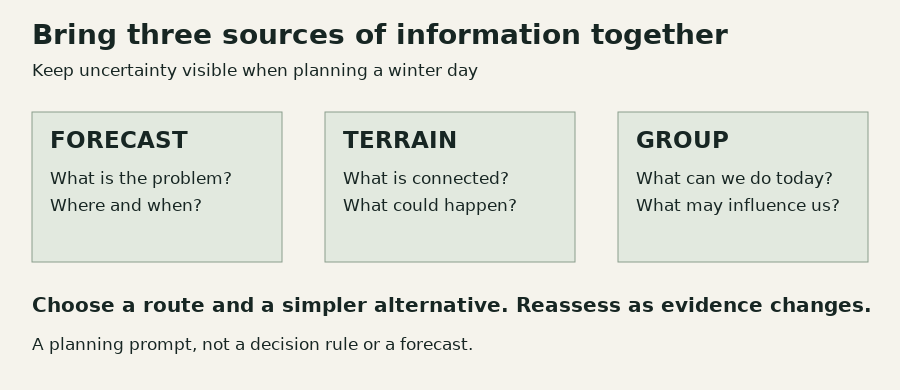
A forecast describes a place and period. Check those boundaries first. Then identify the avalanche problems, where they are expected, their likely size and how conditions may change. Translate that information into places to avoid and realistic alternatives before choosing an objective. A route plan should include suitable places to reconsider, a time to turn back and a way to contact help.
Planning continues during the outing. If what you see differs from what you expected, pause where the group can do so safely. The difference may be important even when you cannot explain its cause. Choose an option that leaves a margin for uncertainty. Changing the objective is a normal part of good judgement.
Sharing yesterday’s screenshot without checking its date, area or update. Find the current original bulletin and preserve an offline copy with its issue time.
Compare two routes against a sample bulletin. Explain the conditions that would make you choose neither.
A good plan must work for the people who will carry it out. Fatigue, cold, equipment difficulties and different expectations can change what is reasonable. Agree how to communicate, where to regroup and how anyone can raise a concern. At a decision point, ask quieter members what they have noticed before the most confident voice settles the answer.
Pressure often arrives quietly: a booked night, a long drive, good snow or another group continuing ahead. Naming the pressure makes it easier to keep it separate from evidence about conditions. A clear decision includes what the group will do next and what would make it stop or change again.
Interpreting silence as agreement. Check understanding directly and give people an easy way to disagree.
One person briefs a route while another introduces fatigue and a third raises uncertainty about overhead terrain. Reach a decision each person can explain.
A transceiver, probe and shovel form a rescue system that each member must know how to use. Equipment in a pack is not the same as rescue readiness. Follow the manufacturer’s checks, service information and carrying instructions for your exact model. Complete the agreed group check and verify that devices are left in the correct travel mode.
Electronics, magnets and metal can interfere with transceivers. Learn the current joint guidance with your actual clothing and equipment. Do not improvise a complicated shutdown ritual in an emergency: use the approved, rehearsed actions. Equipment checks are also a chance to discover unfamiliar controls and resolve problems before the journey begins.
A successful search exercise ends with the transceiver still in search mode. Include a deliberate final-mode check before moving off.
Explain your device’s essential controls to a partner, perform the approved checks and identify where potentially interfering items are carried.
The first decisions establish whether rescuers can act without creating more casualties, who is missing and how help will be called. Searching, locating, digging and providing care are connected tasks. Keep visual clues and missing-person information in mind while using a transceiver; some people may not have a working transmitter.
Your instructor will demonstrate the approved sequence on a nonhuman target, then give you repeated practice. Learn why the search changes as you get closer, why the probe confirms the target location, and why organised excavation matters. Once a casualty is reached, the response continues with care within your training, protection from cold and an accurate handover.
Everyone searches while nobody calls for help or prepares to dig. Allocate tasks and confirm they are happening.
Complete a controlled single-target scenario, then review where time was lost and whether any safety or care task was missed.
An uneventful outing gives you an opportunity to learn, but it does not prove that every decision was sound. Compare what you expected with what you saw. Identify which information changed your mind, which concern was overlooked and which alternative proved useful. Keep a short record that will help you recognise patterns next time.
Rescue skills fade when they are not used. Plan regular safe practice, especially at the start of winter and when equipment changes. Practise with the people you travel with. Use instructors and mentors to explore unfamiliar terrain, travel modes or snow climates rather than assuming that one course settles every future question.
A clean certificate date replaces honest consideration of rusty skills. Use observed practice to decide what needs refreshing.
Write one observation, one decision and one improvement from the day, then set a specific practice date.
You reach a popular track beneath a slope described in the day’s avalanche problem. Several groups have passed. Your planned alternative avoids that slope but takes longer.
Read the forecast for the correct area and time, including the described problem, locations and consequences. The overall danger rating cannot answer whether this particular route is suitable.
Consider where an avalanche could start and where it could travel. A low-angle section can still lie below threatening terrain. Other tracks do not establish that the hazard has gone.
Discuss the alternative before entering the exposed section. Give the least confident member space to explain their concern. Make the decision from the available evidence, not the number of people ahead.
Using popularity or a previous successful trip as evidence that today’s slope is acceptable.
Visibility falls and you can no longer identify the boundary between the intended route and adjacent terrain. Reconsider your ability to follow the plan.
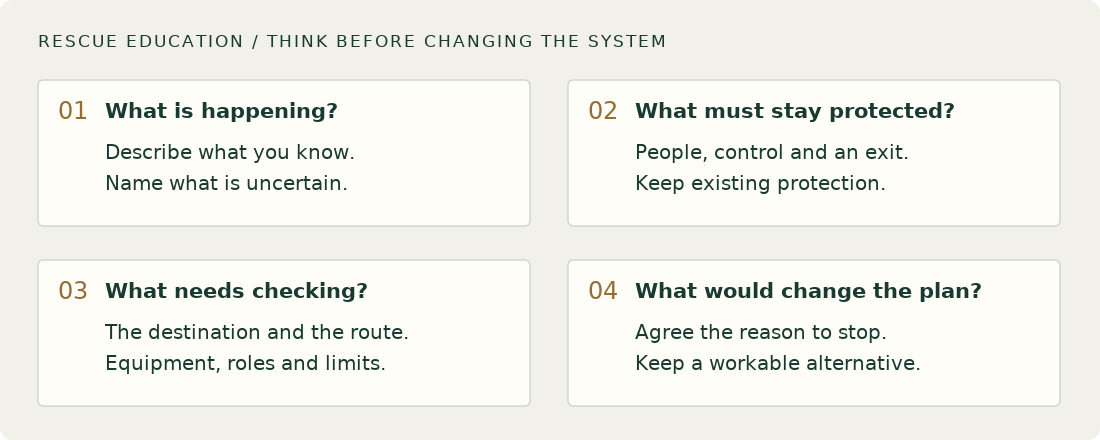
Answer in your own words before reading the explanations near the end of the handbook. These questions support revision; they do not replace practical assessment.
Explain your reasoning before checking the answer.
Explain your reasoning before checking the answer.
Explain your reasoning before checking the answer.
Checked winter training ground and journeys matched to the instructor’s approved travel mode and terrain, with escape options and verified emergency arrangements. Search/digging stations are outside avalanche exposure; assessment never requires hazardous slope entry.
Current serviceable multi-antenna avalanche transceiver for every participant, with manufacturer-approved batteries and carriage
Individual avalanche probe and purpose-designed metal rescue shovel; equipment traceable to instructions and inspection
Suitable winter clothing, spare gloves, eye protection, footwear and equipment for the recorded travel mode
Map/navigation tools, forecast access and offline alternatives; instructor slope-measurement and observation equipment
Emergency communications with backup, group shelter, first-aid kit and feasible evacuation resources
Training transmitters, nonhuman burial targets and care manikins; station boundary markers
Use a named instructor with verified avalanche and winter travel competence in the recorded environment, activity and snow climate; all participants can stop the exercise.
Practise search and digging only in a checked location outside avalanche exposure, including overhead paths and runout, cornices, tree wells, crevasses, traffic and other local hazards. Instructor reassesses after change.
Never bury a living person, even shallowly. Use instrumented bags or manikins. Keep shovel/probe practice away from people and manage cold, fatigue and hand injuries.
No deliberate avalanche triggering or exposure is required to teach or assess these awards. Relocate, postpone or simulate the decision when conditions exceed the approved envelope.
Check every transceiver according to its current manufacturer instructions, battery/service/recall status and the approved interference guidance. Verify final transmit mode and secure carriage before travel.
Pre-brief communication, shelter, emergency contact, evacuation, weather limits and lost-person actions; verify that rescue cover is realistic before leaving the safe area.
A timed exercise never rewards bypassing scene safety, missing-person accounting or casualty care. A safety intervention stops the attempt; record learning and a new independent reassessment.
Assessment records each learner’s observable actions and reasoning. Team success and attendance alone cannot satisfy another person’s outcomes.
Use the approved local clinical annex and training manikins for care demonstrations; activate professional assistance and act within current first-aid training.
Keep individual teaching, practice and assessment evidence; content version, method annex, venue and travel-mode scope accompany the award record.
Use these outcome references with your instructor. Explain your decisions and demonstrate the task under the stated conditions. A safe stop can show judgement; any required physical skill still needs its own observed demonstration.
AV1-A
Explain how unstable snow, terrain and a trigger can combine; distinguish avalanche likelihood from consequences and personal exposure. Demonstrate independently after practice; explain the reason for action and when to stop. Safety-critical failures cannot be offset by strengths elsewhere.
The slope you stand on is gentle but a steep bowl is above it.
Use the signed venue and method annex, appropriate current equipment instructions, realistic snow and dedicated safety coverage. Assess independently after coached practice. Knowledge or simulation can support understanding but cannot replace the practical evidence specified. Record travel mode, snow climate and conditions.
Identify start, track and runout on a map and in the field; explain an avoidance choice. Record individual actions, conditions, dates, method version and assessor judgement. Practical observations are mandatory where named.
AV1-B
Extract date, area, altitude, aspect, problems, likelihood, expected size and trend from a local forecast; identify missing information. Demonstrate independently after practice; explain the reason for action and when to stop. Safety-critical failures cannot be offset by strengths elsewhere.
A screenshot shared yesterday conflicts with the current bulletin.
Use the signed venue and method annex, appropriate current equipment instructions, realistic snow and dedicated safety coverage. Assess independently after coached practice. Knowledge or simulation can support understanding but cannot replace the practical evidence specified. Record travel mode, snow climate and conditions.
Select the current applicable source and relate its messages to two proposed routes. Record individual actions, conditions, dates, method version and assessor judgement. Practical observations are mandatory where named.
AV1-C
Recognise terrain traps, connected slopes and overhead hazards; choose conservative route and regrouping locations. Demonstrate independently after practice; explain the reason for action and when to stop. Safety-critical failures cannot be offset by strengths elsewhere.
An established track crosses beneath a loaded gully.
Use the signed venue and method annex, appropriate current equipment instructions, realistic snow and dedicated safety coverage. Assess independently after coached practice. Knowledge or simulation can support understanding but cannot replace the practical evidence specified. Record travel mode, snow climate and conditions.
Show a lower-exposure alternative without treating tracks as evidence of stability. Record individual actions, conditions, dates, method version and assessor judgement. Practical observations are mandatory where named.
AV1-D
Set objectives, alternatives, decision points, turnaround triggers and an emergency plan suited to the weakest participant. Demonstrate independently after practice; explain the reason for action and when to stop. Safety-critical failures cannot be offset by strengths elsewhere.
A late start makes the preferred route increasingly rushed.
Use the signed venue and method annex, appropriate current equipment instructions, realistic snow and dedicated safety coverage. Assess independently after coached practice. Knowledge or simulation can support understanding but cannot replace the practical evidence specified. Record travel mode, snow climate and conditions.
Brief an adjusted plan and an acceptable no-go option. Record individual actions, conditions, dates, method version and assessor judgement. Practical observations are mandatory where named.
AV1-E
Inspect personal kit; complete the approved group transceiver check and final transmit/carriage check; identify interference concerns. Demonstrate independently after practice; explain the reason for action and when to stop. Safety-critical failures cannot be offset by strengths elsewhere.
A partner’s device passes one check but is left in search mode.
Use the signed venue and method annex, appropriate current equipment instructions, realistic snow and dedicated safety coverage. Assess independently after coached practice. Knowledge or simulation can support understanding but cannot replace the practical evidence specified. Record travel mode, snow climate and conditions.
Demonstrate corrected readiness with the actual equipment, following its instructions. Record individual actions, conditions, dates, method version and assessor judgement. Practical observations are mandatory where named.
AV1-F
Recognise relevant weather change, recent avalanches, collapsing/cracking and other instability clues; communicate and revise the plan. Demonstrate independently after practice; explain the reason for action and when to stop. Safety-critical failures cannot be offset by strengths elsewhere.
Visibility deteriorates before a route decision.
Use the signed venue and method annex, appropriate current equipment instructions, realistic snow and dedicated safety coverage. Assess independently after coached practice. Knowledge or simulation can support understanding but cannot replace the practical evidence specified. Record travel mode, snow climate and conditions.
Stop at a suitable location, explain uncertainty and choose a conservative next step. Record individual actions, conditions, dates, method version and assessor judgement. Practical observations are mandatory where named.
AV1-G
Use agreed communication and travel protocols; invite concerns and keep decisions explicit. Demonstrate independently after practice; explain the reason for action and when to stop. Safety-critical failures cannot be offset by strengths elsewhere.
The most confident person dismisses another member’s concern.
Use the signed venue and method annex, appropriate current equipment instructions, realistic snow and dedicated safety coverage. Assess independently after coached practice. Knowledge or simulation can support understanding but cannot replace the practical evidence specified. Record travel mode, snow climate and conditions.
Facilitate a short check-in and record a decision everyone understands. Record individual actions, conditions, dates, method version and assessor judgement. Practical observations are mandatory where named.
AV1-H
Establish scene safety and missing-person information; activate help and demonstrate an approved single-target transceiver/probe search. Demonstrate independently after practice; explain the reason for action and when to stop. Safety-critical failures cannot be offset by strengths elsewhere.
The search display behaves unexpectedly near carried electronics.
Use the signed venue and method annex, appropriate current equipment instructions, realistic snow and dedicated safety coverage. Assess independently after coached practice. Knowledge or simulation can support understanding but cannot replace the practical evidence specified. Record travel mode, snow climate and conditions.
Locate a nonhuman buried target, preserving the search process and correcting the problem safely. Record individual actions, conditions, dates, method version and assessor judgement. Practical observations are mandatory where named.
AV1-I
Demonstrate coordinated digging to a nonhuman target and transition to the locally approved basic care and emergency handover. Demonstrate independently after practice; explain the reason for action and when to stop. Safety-critical failures cannot be offset by strengths elsewhere.
Digging space is crowded and progress stalls.
Use the signed venue and method annex, appropriate current equipment instructions, realistic snow and dedicated safety coverage. Assess independently after coached practice. Knowledge or simulation can support understanding but cannot replace the practical evidence specified. Record travel mode, snow climate and conditions.
Reorganise excavation, expose the manikin appropriately, initiate care within training and give a concise handover. Record individual actions, conditions, dates, method version and assessor judgement. Practical observations are mandatory where named.
AV1-J
Explain the basis and limits of the day’s decisions; set a realistic winter practice and refresh plan. Demonstrate independently after practice; explain the reason for action and when to stop. Safety-critical failures cannot be offset by strengths elsewhere.
A successful trip is described as proof every decision was correct.
Use the signed venue and method annex, appropriate current equipment instructions, realistic snow and dedicated safety coverage. Assess independently after coached practice. Knowledge or simulation can support understanding but cannot replace the practical evidence specified. Record travel mode, snow climate and conditions.
Separate outcome from decision quality and identify one specific improvement. Record individual actions, conditions, dates, method version and assessor judgement. Practical observations are mandatory where named.
Start with the information in the problem. State your assumptions, choose a safe objective and explain what would make you change the plan. Apply technical skills only in the approved supervised exercise.
A planned outing meets a revised forecast and a slower participant.
Route options, forecast interpretation, team brief and justified go/modify/no-go choice.
Use checked terrain and nonhuman targets outside avalanche exposure. Separate learning from final assessment. Approved station annex fixes area, target geometry, snow conditions, realistic time expectations and safety cover before pilot; no arbitrary universal pass time.
In a controlled station one person is reported missing and a training target is buried.
Scene safety, call for help, search/probe/dig sequence, basic care and handover.
Use checked terrain and nonhuman targets outside avalanche exposure. Separate learning from final assessment. Approved station annex fixes area, target geometry, snow conditions, realistic time expectations and safety cover before pilot; no arbitrary universal pass time.
A visible track conflicts with the group’s terrain plan as weather worsens.
Recognition, communication and an alternative route or retreat.
Use checked terrain and nonhuman targets outside avalanche exposure. Separate learning from final assessment. Approved station annex fixes area, target geometry, snow conditions, realistic time expectations and safety cover before pilot; no arbitrary universal pass time.
The assessor records your individual decisions and practical performance. The ratings are I for independent and safe, C for coached or incomplete, N for not observed and S for a safety intervention. A missing or unsafe outcome cannot be balanced by a strong performance elsewhere.
Your approved course instructor may also assess this recreational award. Teaching and coached practice are separated from the final independent demonstration. You can ask for the reasons for a result and use the independent appeal route if you disagree.
If evidence is incomplete, you receive the observed gaps and a targeted practice plan. Reassessment checks the affected skills and their interaction in a scenario. Use the private support route for an appeal or a correction to your record.
After a recorded pass, submit the short course evaluation. Critical feedback and positive feedback have exactly the same effect on eligibility. Your certificate includes the assessment date, instructor, programme edition and a verification code. An award image alone is not a verifiable credential.
Keep a short record for each practice session. Do not enter unnecessary medical details or another person’s private information. A practice log supports learning; the course record and award remain in the portal.
Date and location
Skill or outcome reference
Conditions and equipment or method reference
What I did and why
Feedback and any intervention
What I will practise next and with whom
No. The rating describes regional conditions for a stated period. Local terrain and the specific avalanche problem still matter.
It makes changing the plan practical and reduces pressure to continue simply because no one has considered another option.
No. The person still needs to be located precisely, reached, excavated and cared for. Practise the whole approved response.
Aspect — The direction a slope faces.
Runout — Terrain an avalanche can reach below its starting zone.
Terrain trap — A feature that can increase the consequences of being caught, such as a gully or abrupt drop.
Avalanche problem — A description of the type and distribution of avalanche hazard used in a forecast.
Use the current instructions for the exact model of equipment on your course. Check its intended use, compatible components, inspection points and operating limits. A similar-looking device may behave differently.
Ask your instructor to show how the approved method sheet and equipment instructions fit together. Report anything that is unclear before practical use. The references below are selected primary sources; they do not certify this course.
EAWS danger scale Reviewed November 2026
International warning-service communication standard.
EAWS avalanche problems Reviewed November 2026
Warning-service terminology and guidance.
SAIS Be Avalanche Aware Reviewed November 2026
Public prevention/decision guidance.
ICAR search phases Recommendation 009, updated 2025 Reviewed November 2026
Rescue commission recommendation.
Joint recreational transceiver interference guidance, hosted CAIC Reviewed November 2026
Manufacturer/forecast-centre collaborative technical guidance.
ERC 2025 Special Circumstances final guideline Reviewed November 2026
Clinical guideline, not instructor/award standard.